
 |  |  |
The Great Divergence: Challenging the Soft Landing Narrative
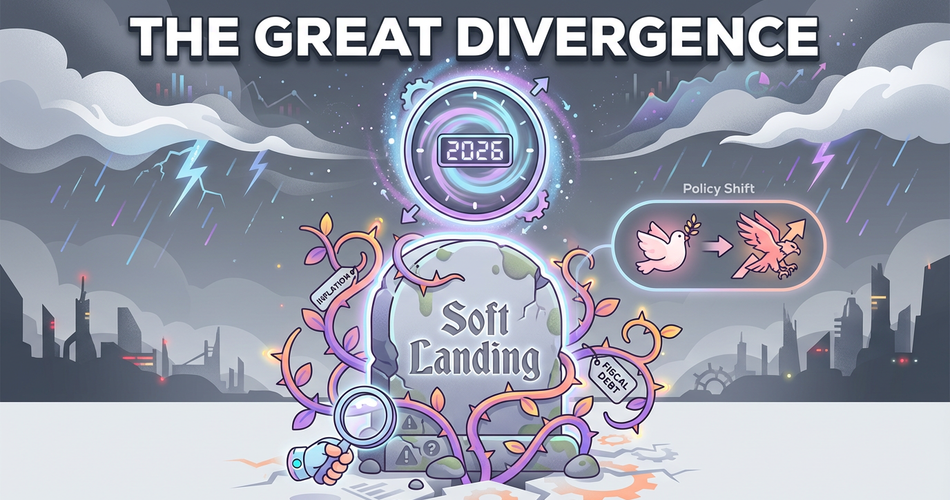
For years, the global economy has moved with a certain synchronized rhythm, largely orchestrated by the US Federal Reserve. Central banks worldwide often echoed the Fed's monetary policy, creating a harmonious (or at least predictable) financial environment. However, this era of synchronized movements may be drawing to a dramatic close. We are on the precipice of what could be 'The Great Divergence'—a period where global central banks, far from playing in harmony, might begin to pursue vastly different tunes, leading to unprecedented economic challenges and opportunities.
Imagine an orchestra where the conductor signals a slowdown, while the principal musicians rebel, accelerating into a crescendo. This isn't a theoretical musing but a very real scenario that could materialize as early as 2026. This vision starkly contrasts with the popular 'soft landing' narrative and the widespread expectation of synchronized global easing. According to astute strategists at Deutsche Bank, we might be headed for a 'negative curveball': a Federal Reserve rate hike in 2026.

Unpacking the Prevailing Consensus vs. Emerging Reality
The current market consensus paints a comforting picture: a controlled deceleration where the Fed gradually cuts rates to a 'neutral' 3.0% to 3.25% by 2026, fueled by cooling inflation and a softening labor market. Equity valuations are largely soaring on this very assumption—a metaphorical return to a Fed put that ensures market stability.
"The market envisions a controlled deceleration... But I'm here to tell you that this consensus, this beautiful lullaby, rests on a foundation that is far more precarious than we realize."
However, this comfortable narrative might be built on shaky ground. The primary driver for this potential upheaval is divergence. While 2022 and 2023 saw central banks unite in a global effort to tame inflation, 2025 and 2026 are shaping up to be dramatically different.

The Looming Threat of Global Policy Arbitrage
What if the European Central Bank (ECB), the Bank of Japan (BOJ), and the central banks of Australia and Canada all signal tightening cycles, driven by their unique domestic inflation pressures and fiscal stimuli? This would occur precisely when the US Federal Reserve might be contemplating rate cuts.
This scenario creates a significant global interest rate arbitrage, fundamentally altering financial flows. If the Fed cuts aggressively while global peers are hiking:
- The appeal of the US dollar as a high-yield asset diminishes.
- This could lead to a weaker dollar.
- A weaker dollar makes imports more expensive, effectively importing inflation back into the US economy.
This represents a classic lose-lose scenario for the Fed's inflation fight. But the pressure isn't solely external.
The Fiscal Tsunami: Fueling the Fire at Home
Domestically, the US fiscal landscape is also working against the Fed's disinflationary goals. We're not talking about subtle policy nudges; we're talking about a fiscal tsunami.
Consider the hypothetical One Big Beautiful Bill Act taking effect in July 2025. This, combined with an aggressive new tariff regime, could boost US GDP by nearly one percent in 2026 while adding almost three-quarters of a percentage point to headline inflation.
"The Fed is trying to cool an economy, and then Congress effectively pours gasoline on the fire. How can monetary policy effectively function when fiscal policy is pulling so aggressively in the opposite direction?"
It's akin to trying to brake a car while simultaneously hitting the accelerator. Such aggressive fiscal expansion makes the Fed's task of controlling inflation immensely more difficult, pushing monetary policy towards a tighter stance rather than an easing one.

The Taylor Rule Alarms: Are Rates Already Too Low?
For those who appreciate the technical underpinnings of monetary policy, the Taylor Rule provides a critical perspective. This framework suggests an appropriate interest rate based on inflation and the economic output gap. When we adjust this rule for sustained inflation and a potentially higher neutral interest rate (what economists call r-star), a concerning picture emerges:
- Higher Inflation Persistence: Inflation has proven more stubborn than anticipated.
- Higher Neutral Rate (
r-star): The theoretical rate at which the economy is neither stimulating nor contracting might be higher than previously thought.
The implication? Current policy rates may already be too accommodative given the economic heat generated by this fiscal dominance. In simpler terms, the Fed isn't tight enough now, let alone if it were to cut rates. Cutting rates under these conditions would be akin to throwing fuel on an already smoldering fire.
Institutional Fragility: A Shadow from the 1970s
Beyond economic forces, the fragility of institutions adds another layer of risk. Jerome Powell's term as Fed Chair expires in May 2026. A strong possibility exists that a new leader, perhaps one openly advocating aggressive rate cuts despite sticky inflation, could step in.
This scenario draws unsettling parallels to the Arthur Burns era of the 1970s. Under intense political pressure, then-Fed Chair Burns kept interest rates artificially low, allowing inflation to become deeply entrenched and leading to the 'Great Inflation'—a period of disastrous stop-go policy.
"A premature easing cycle, driven by political pressure rather than economic data, could unleash a resurgence of inflation so potent that the Federal Reserve would be forced to reverse course and hike aggressively by late 2026."
This stop-go dynamic—a politically motivated cut followed by a forced hike—represents the most dangerous type of volatility for markets and the economy, precisely the scenario Deutsche Bank is warning us about.
Three Critical Vectors for a 2026 Hike
The conditions for a 2026 Fed rate hike are coalescing around three critical vectors:
- Fiscal-Monetary Conflict: Tariff-induced inflation and massive fiscal stimulus neutralize the Fed's disinflationary efforts, creating an internal contradiction in economic policy.
- Global Policy Arbitrage: Foreign central bank tightening places a floor under global bond yields, weakens the dollar, and imports inflation back into the US.
- Institutional Fragility: A leadership transition at the Fed risks a
stop-gopolicy error, potentially sacrificing independence for short-term political gain.

The Global Reverse Script: Europe and Japan's Independent Stance
Let's delve deeper into this reverse script playing out globally.
The Eurozone: A Hawkish Turn
The European Central Bank, historically often seen as a dovish follower of the Fed, is charting an increasingly independent and hawkish course for 2026. Swap markets are already pricing in a 30% probability of an ECB rate hike by the end of 2026. Why?
- Stubbornly high Eurozone inflation, particularly in services.
- Stronger-than-expected wage growth.
- Massive fiscal stimulus packages in economic engines like Germany.
If the ECB holds or even hikes rates while the Fed cuts, it dramatically shifts the interest rate differential in favor of the Euro, potentially exporting inflation back to the US via a weaker dollar.

Japan: Normalization and Repatriation Risks
The Bank of Japan represents perhaps the most significant structural shift in global finance. After decades of zero interest rate policy and battling deflation, Japan is finally normalizing its monetary policy. The consensus expects the BOJ to hike rates in 2026, potentially reaching a policy rate of one percent.
This shallow tightening carries profound implications:
- For years, the Japanese Yen has been the preferred funding currency for the global carry trade.
- As Japanese rates rise, this trade becomes less attractive, prompting capital repatriation back to Japan.
- This repatriation involves selling US assets and buying Yen, which pushes up the value of the Yen and can drive down the value of US Treasuries. This dynamic would force US long-term yields higher, regardless of what the Fed attempts to do—a classic
bond vigilanteaction from Tokyo.
Fiscal Dominance: Tariffs and the Big Bill Act
The domestic fiscal dominance is a critical piece of this puzzle. The One Big Beautiful Bill Act—a hypothetical but plausible piece of legislation—would permanently extend tax cuts, introduce new deductions, and expand the Child Tax Credit. The Congressional Budget Office estimates such a bill would increase the federal deficit by $3.4 trillion.
In the short term, this act is expected to boost real GDP by almost one percent in 2026, primarily by increasing demand in an economy that already has a positive output gap. This is textbook overheating. When fiscal policy is aggressively expansionary, monetary policy must be tighter to counteract the inflationary impulse. Yet, the Fed is discussing rate cuts—a fundamental contradiction.
Moreover, the imposition of new tariffs isn't just a one-off price shock; they represent a structural floor for inflation. Tariffs make it incredibly difficult to bring inflation back to the target two percent, as they directly increase the cost of imported goods.
Navigating the New Reality: Investment Implications
So, what does this mean for investors and our financial future?
- Equity Market: The market's
soft landingpricing is creating a valuation trap. Elevated multiples in the S&P 500 assume a perfect disinflationary outcome. If the Fed is forced to hike, or if the ten-year Treasury yield rises to five percent, the equity risk premium will collapse. TheAI Bubble, heavily reliant on low costs of capital, could burst. - Fixed Income: Forget long-duration bonds. Instead, short-duration credit and Treasury Inflation-Protected Securities (TIPS) offer better protection against rising rates and inflation.
- Currencies: Expect massive volatility.
- Commodities: Gold becomes a critical hedge against dollar debasement. Energy and industrial commodities could benefit if we are truly entering a
no landinggrowth scenario, where growth remains strong but inflation persists.

Prepare for the Storm
The prevailing narrative of a comfortable soft landing might be dangerously complacent. Deutsche Bank's contrarian prediction of a 2026 Fed rate hike isn't a mere tail risk; it's a plausible outcome grounded in robust analysis of fiscal dominance, global policy divergence, and the chilling lessons from history.
The consensus view assumes a precision in monetary policy execution that is historically rare, especially when confronted with overwhelming political pressure. The reverse script of global central banks hiking while the Fed considers cutting creates an untenable tension.
"The calm we experience in the market right now might not be a permanent state. It might just be the eye of a potential inflationary storm. And it's up to us to prepare for it."
It is imperative for investors, policymakers, and individuals alike to prepare for this potential shift. Understanding these dynamics is the first step in navigating what could be a turbulent but transformative economic period.
 |  |  |