
 |  |
Beyond the Headlines: Decoding Huawei's 2024 Annual Report
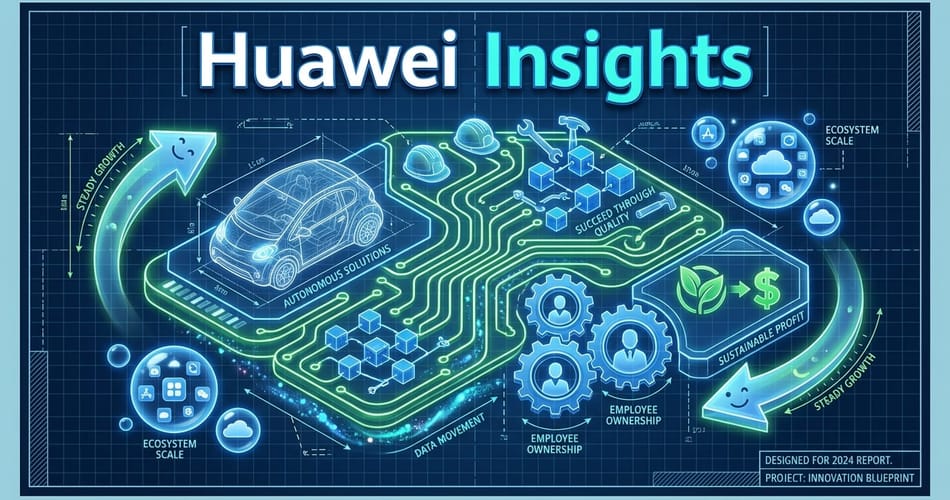
In a world saturated with fleeting headlines and fast-paced news cycles, truly understanding the strategic trajectory of a technology giant like Huawei requires a deeper dive. Conventional wisdom often falls short, and to grasp the nuances of such an influential company, one must look past the noise and into the very DNA of its operations. Few documents offer a more revealing glimpse than an annual report—a comprehensive, data-rich look at performance, strategy, and philosophy. It's here that surprising details and counter-intuitive approaches often emerge, painting a far more complete picture than any news article ever could.
This article distills six pivotal insights from Huawei's 2024 annual report. These insights transcend common narratives, unveiling a company guided by a distinct set of principles and offering a clearer view of its current state and future direction.
1. Calm Amidst the AI Frenzy: A Measured Approach
While the global tech industry is consumed by an AI frenzy, with companies scrambling to announce new models and features, Huawei's 2024 report reveals a surprisingly measured and grounded approach. Instead of chasing hype, the company's leadership advocates for a long-term, steady strategy focused on strengthening foundational technologies. This philosophy of calm might seem counter-intuitive for a major tech firm, especially when the market often expects companies to rush recklessly ahead for first-mover advantages.
"AI is driving a great transformation in society, bringing unprecedented, long-term opportunities. And while we embrace opportunity, we reject opportunism."
Huawei's approach appears to be a calculated decision, a conscious effort to avoid being driven by short-term bubbles. This isn't mere rhetoric; it's backed by specific strategic initiatives—the Tianshui, Dishui, and Pacific Ocean plans—designed to methodically seize strategic opportunities in AI and computing. In an era of breakneck speed, Huawei is choosing patience. By rejecting opportunism, they are positioning themselves to build more durable, long-term competitive strengths in the core hardware, software, and cloud platforms essential for the industry's intelligent transformation.
The company's Rotating Chairwoman articulated this philosophy powerfully: “AI is driving a great transformation in society, bringing unprecedented, long-term opportunities. And while we embrace opportunity, we reject opportunism.” This statement underscores a strategic pillar: they envision the future but are building it brick by brick, ensuring a solid foundation rather than skipping steps.
2. Intelligent Automotive Solutions Ignite: A New Growth Engine
While much attention often focuses on Huawei's established business lines, one of the most startling figures in the report is the monumental growth of its Intelligent Automotive Solution (IAS) business. This segment achieved two major milestones in 2024:
- It turned a profit for the first time.
- Its revenue grew by a staggering 474.4% year-over-year.

This nearly five hundred percent growth in a single year is remarkable. The report clarifies Huawei's strategy here: they are not interested in building their own cars. Instead, they position themselves as a key technology supplier, providing new intelligent components for vehicles. This empowers automotive partners like AITO, LUXEED, and STELATO to build competitive smart vehicles.
The market validation for this model is potent. The AITO M9, powered by Huawei's technology, has become the best-selling model among vehicles priced at 500,000 Chinese Yuan and above. This isn't merely about growth; it's about market dominance in a lucrative premium segment. In 2024 alone, vehicles powered by HUAWEI ADS, their Advanced Driving System, drove over 1.4 billion kilometers with intelligent driving. This achievement marks a successful diversification into the high-margin automotive components sector, validating a strategy of leveraging their deep ICT expertise to enter adjacent markets. Huawei has truly ignited a brand-new growth engine.
3. Succeed Through Quality: A Core Strategic Imperative
The concept of quality is often mentioned but rarely elevated to a strategic imperative. Throughout its report, Huawei transforms product quality from a standard operational goal into a core strategic focus, repeatedly referring to quality as our lifeline and formalizing this under the banner of Succeed Through Quality.
What makes this truly remarkable is the ambition behind it: a stated goal to provide customers with products that are maintenance-free throughout their lifecycles. In a tech landscape often associated with planned obsolescence, where devices are designed to be replaced, this commitment represents a fundamentally different approach.
The report emphasizes an end-to-end quality management system that extends beyond internal R&D, reaching out to suppliers and partners. This indicates that their strategy isn't just about internal excellence but about building a fully integrated, high-quality value chain from the ground up. This philosophy is a deep-seated strategy to earn long-term customer loyalty and trust.
4. Employee Ownership: A Unique Model for Shared Destiny
In an era dominated by publicly traded corporations and venture capital-backed firms, Huawei's ownership structure is a significant outlier. The report confirms a surprising fact: Huawei is a private company, wholly owned by its employees via an Employee Shareholding Scheme. As of the end of 2024, this scheme involved 161,749 individuals.

Perhaps the most counter-intuitive detail is the stake held by the company's founder, Mr. Ren Zhengfei, who holds only about 0.65% of the company's total share capital—less than one percent!
"Imagine a company where nearly everyone has a direct stake in its generational success, not just its quarterly earnings. It fosters a different kind of commitment, a different kind of loyalty."
This model is radically different from that of other major global corporations. It's designed to directly align the contributions and motivations of its employees with the company's long-term development and success, creating a powerful link between individual effort and collective prosperity. This fosters a unique kind of commitment and loyalty, where employees are invested in the company's generational success, not just its quarterly earnings.
5. Sustainability as a Profitable Growth Engine
While many technology firms relegate Environmental, Social, and Governance (ESG) initiatives to marketing or compliance departments, often leading to accusations of greenwashing, Huawei’s report shows they have weaponized sustainability, transforming it into a core, high-growth business unit. Their Digital Power segment is a powerful demonstration of a model where decarbonization is not an operational tax but a primary commercial engine.
The scale of its impact is massive:
- By the end of 2024, Huawei Digital Power helped customers generate 1.4113 trillion kilowatt-hours of green power.
- It reduced carbon dioxide emissions by more than 710 million metric tons.
To put that in tangible terms, this reduction is equivalent to planting 970 million trees. Nearly a billion trees' worth of carbon removed annually! Critically, this monumental environmental impact is directly tied to business success. The Digital Power segment's revenue grew by a robust 24.4% in 2024. This provides a powerful, real-world case study of how tackling climate change can be a potent engine for economic growth, not just an operational cost. It's a win-win for both the planet and their balance sheet, demonstrating a powerful synergy where doing good is also good business.
6. The Scale of Global Ecosystems: Critical Mass Achieved
A platform's long-term viability depends on achieving a critical mass of developers and users. The 2024 report provides concrete metrics showing that Huawei's ecosystems have reached a staggering scale, directly countering any narrative of them being isolated or purely domestic. These figures serve as evidence of a successful strategy to build self-sustaining platforms capable of long-term global competition.
The key ecosystem figures speak for themselves:
- HarmonyOS: Over 7.2 million registered developers and more than 20,000 apps and atomic services. This isn't just an operating system; it's a rapidly expanding universe of innovation, attracting talent and driving new applications.
- Huawei Cloud: Boasts more than 7.8 million developers and 45,000 partners.
- HUAWEI Health App: Serves more than 540 million users worldwide, with 110 million monthly active users.

These numbers represent a significant global community actively building on and engaging with Huawei's platforms. This scale is what transforms a proprietary technology into a viable, long-term ecosystem with the critical mass necessary to compete. It's no longer just a company; it's a world within itself.
The Power of Deliberate Growth
Taken together, these insights from Huawei's 2024 report paint a compelling picture of a global technology giant operating on a distinctly different set of principles. While competitors chase market hype, Huawei appears laser-focused on foundational engineering. While others optimize for short-term shareholder value, its unique employee-owned structure aligns perfectly with its long-term vision. And while many treat sustainability as a compliance cost, Huawei has forged it into a profitable growth engine.
This approach, rooted in long-term strategic patience, an obsession with foundational quality, and a commitment to employee ownership, offers a compelling contrast to the often frenetic pace of the industry. As the world navigates the turbulent changes brought by artificial intelligence, what lessons can we glean from a company that chooses to reject opportunism in favor of building slowly, succeeding through unwavering quality, and empowering its people? Perhaps the greatest lesson is that in a world obsessed with speed, there is still immense power in deliberate, foundational growth.
 |  |