
 |  |  |  |
Your greatest triumphs can paradoxically sow the seeds of your downfall. This isn't merely a philosophical musing but the terrifying central insight of Johan Norberg's monumental work, Peak Human. It argues that every golden age, every pinnacle of human achievement, inherently creates the conditions for its own demise – a cruel twist of history that demands our attention.
The opening days of January 2026 presented a stark, real-world illustration of Norberg's theories. On one side, his book landed like a bombshell, providing a comprehensive roadmap for the rise and, crucially, the collapse of civilizations. On the other, the United States military executed a precision operation, dismantling the Maduro regime in Venezuela – a contemporary example of a completely closed society. This was no mere coincidence; it was Norberg’s theories unfolding in real-time, serving as an operational manual for decision-makers navigating a volatile global landscape.
The Anglosphere faces a critical choice: recommit to the uncomfortable, dynamic, and inherently risky path of openness, or succumb to the protective stagnation that has claimed every great power before it. My analysis, drawing from Peak Human, the economic insights of Martin Wolf from the Financial Times, and intelligence from the Venezuelan theater, asserts a profoundly important point: the 'Great Closing' – the creeping trend toward protectionism, nativism, and state control – is the single biggest threat to our current global order. January 2026 was both a dire warning and a potential turning point.
Let's delve into Norberg’s framework, the very architectonics of decline.
The Pillars of "Peak Human"
Norberg’s Peak Human, published in January 2026, arrives at a moment of palpable anxiety in the Western world. Building on his earlier, more optimistic works, this book offers a cautionary, diagnostic tone. His central thesis is revolutionary in its simplicity: Golden Ages are not random occurrences of geography, genetics, or divine intervention. Instead, they are the precarious byproducts of one specific sociopolitical orientation: openness.
Norberg defines openness not as a vague sentiment, but as a rigorous structural condition supported by four crucial pillars:
- Open Exchange: This refers to the uninhibited flow of goods, capital, and services across borders. It fosters competitive pressure, driving efficiency and sparking innovation. Think of it as the lifeblood of a thriving economy.
- Open Doors: This is the mobility of human capital, allowing societies to import talent, ambition, and sheer labor. It ensures that the brightest and most driven can contribute where they are most effective.
- Open Minds: This signifies a cultural and intellectual receptivity to external ideas. It's a willingness to challenge domestic orthodoxies, break taboos, and relentlessly pursue truth. It is curiosity, unchained by dogma.
- Open Societies: This is the institutional framework that protects these flows. It includes the rule of law, bedrock property rights, and meaningful constraints on arbitrary state power. This is the structure that allows dynamism to flourish without descending into chaos.
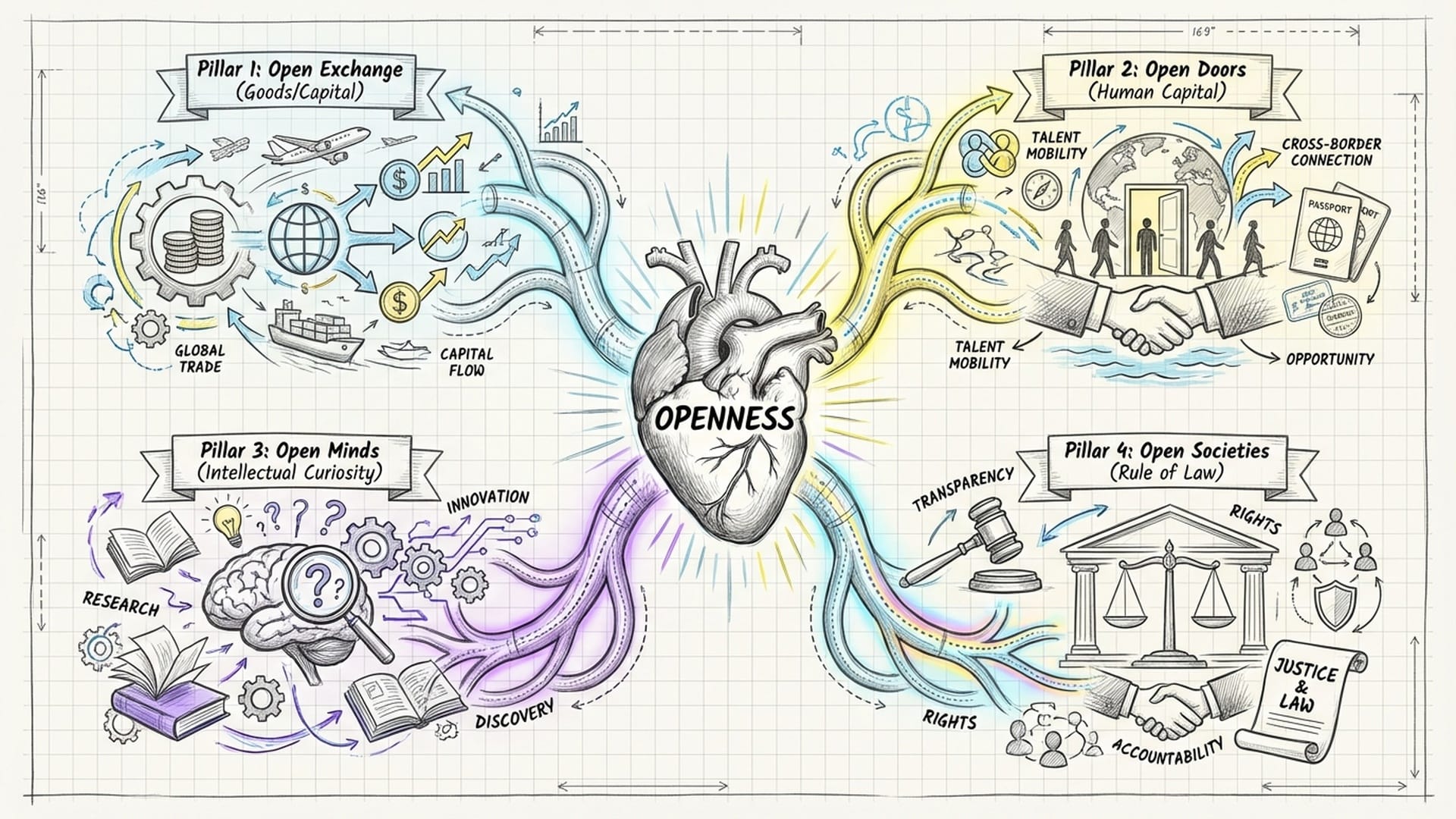
Norberg argues that when these four pillars align, humanity achieves 'Peak Human' status – periods marked by exponential growth in wealth, staggering artistic output, and scientific breakthroughs.
"The profound, heartbreaking tragedy inherent in Norberg’s model: this state, this 'Peak Human' state, is inherently unstable. The very prosperity that openness generates? It creates the seeds of its own destruction."
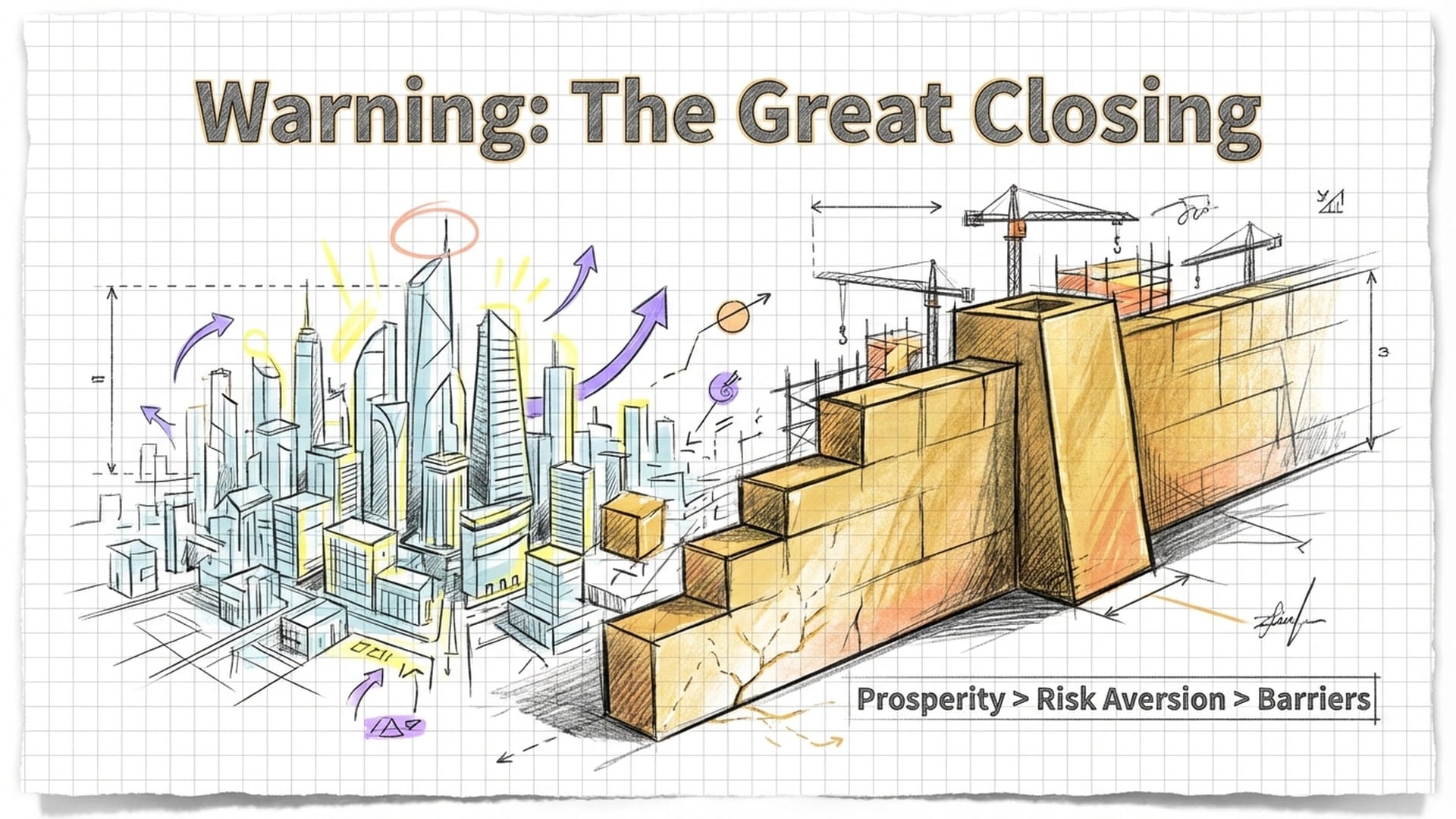
This core paradox is central to Norberg's thesis. As societies grow rich, they become risk-averse. Those who have benefited most—incumbent elites—begin to fear the 'creative destruction' of the market and the influx of new ideas. They respond by erecting barriers: 'Open Minds' calcify into rigid orthodoxy, 'Open Doors' are slammed shut by rising nativism, and 'Open Exchange' is strangled by protectionism and 'us first' policies. This process, chillingly termed 'The Great Closing,' is the historical constant that has extinguished every flame of human flourishing.
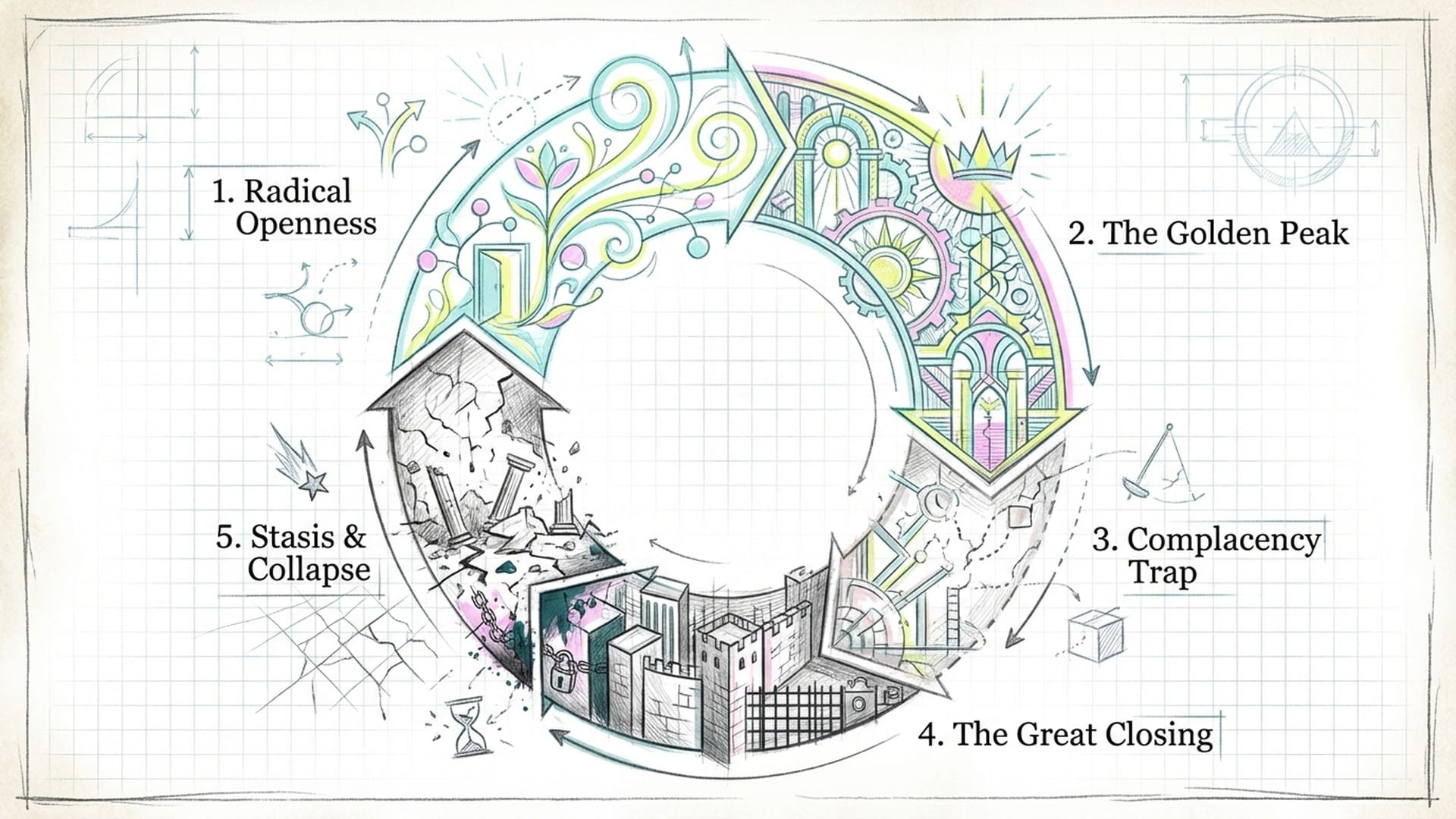
The Civilization Cycle: From Openness to Collapse
Visualizing this cycle reveals a chilling pattern. Norberg’s analysis details a recurring lifecycle for every civilization, a pattern that decision-makers in 2026 must urgently recognize:
- Radical Openness: Often born from necessity after chaos or tyranny, societies open themselves to the world. They trade, learn, and welcome outsiders, creating a virtuous cycle of innovation.
- The Golden Peak: The accumulation of talent and capital ushers in a golden age of flourishing art, science, and commerce. The society feels invincible.
- The Complacency Trap: Abundance breeds complacency. Citizens begin to perceive their success as an inherent right, forgetting the specific choices that led to it. Focus shifts from creating new wealth to distributing existing wealth.
- The Great Closing: Threatened by external competition and internal change, society enacts protective measures. Tariffs rise, borders close, and dissent is silenced in favor of 'stability.'
- Stasis and Collapse: Cut off from its vital sources, the civilization stagnates, becoming fragile and brittle. It eventually collapses under external or internal pressures.
Norberg warns that this fate is not impossible for the modern Anglosphere.
Case Studies in Openness and Closure
Norberg validates his thesis through a rigorous comparative examination of seven distinct civilizations, presenting them not as dusty relics, but as data sets revealing the algorithm of success and the pathology of failure.
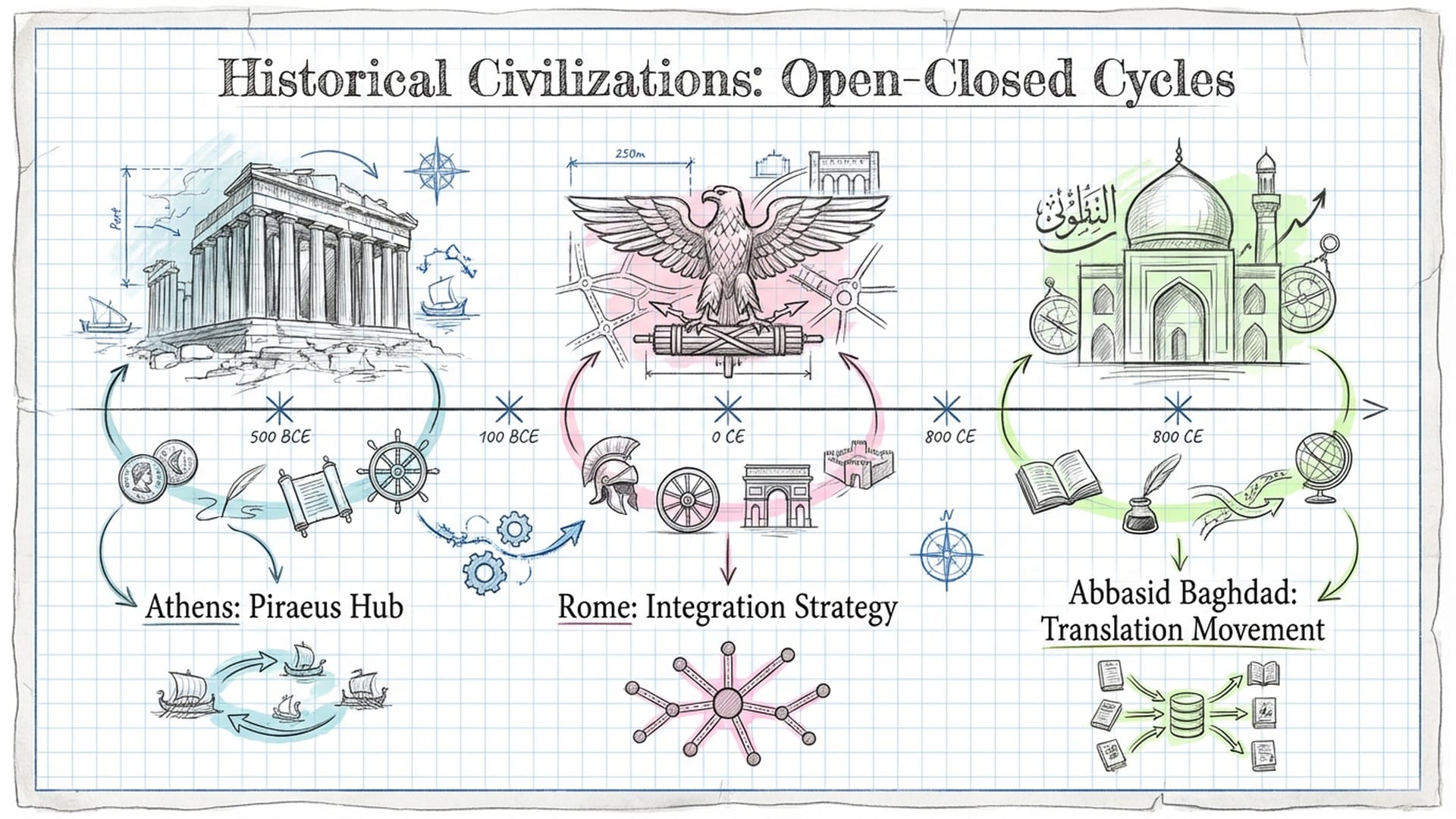
- Ancient Athens: The Laboratory of Democracy: Athens' miracle stemmed from its radical openness to the Aegean world. Its port, Piraeus, was a cosmopolitan hub where goods and ideas flowed freely, laying the groundwork for the rule of law. Its 'Open Mind' was evident in its philosophy, questioning gods and state. Athens fell when it betrayed its principles, succumbing to empire and exclusion. The trial of Socrates symbolized the closing of the 'Open Mind,' where stability outweighed uncomfortable questioning.
- The Roman Republic: Integration as Strategy: Rome excelled in 'Open Doors' and 'Open Societies.' Its genius was integration, extending rights and citizenship to conquered peoples, enabling it to absorb manpower and brainpower from across the Mediterranean. This radical inclusivity fueled its military and administrative longevity. Its downfall began with the shift to an autocratic Empire, where the rule of law was replaced by arbitrary power, and a state-controlled economy stifled social mobility.
- Abbasid Baghdad: The Intellectual Sponge: During Europe’s Dark Ages, Baghdad was the world's intellectual capital. The Abbasids aggressively embraced 'Open Minds,' coveting foreign knowledge. The 'Translation Movement' saw Greek, Persian, and Indian works translated, leading to foundational advancements in mathematics, astronomy, and medicine. Decline set in when the 'gates of ijtihad' (independent reasoning) closed, replaced by religious orthodoxy and a rejection of 'foreign' sciences.
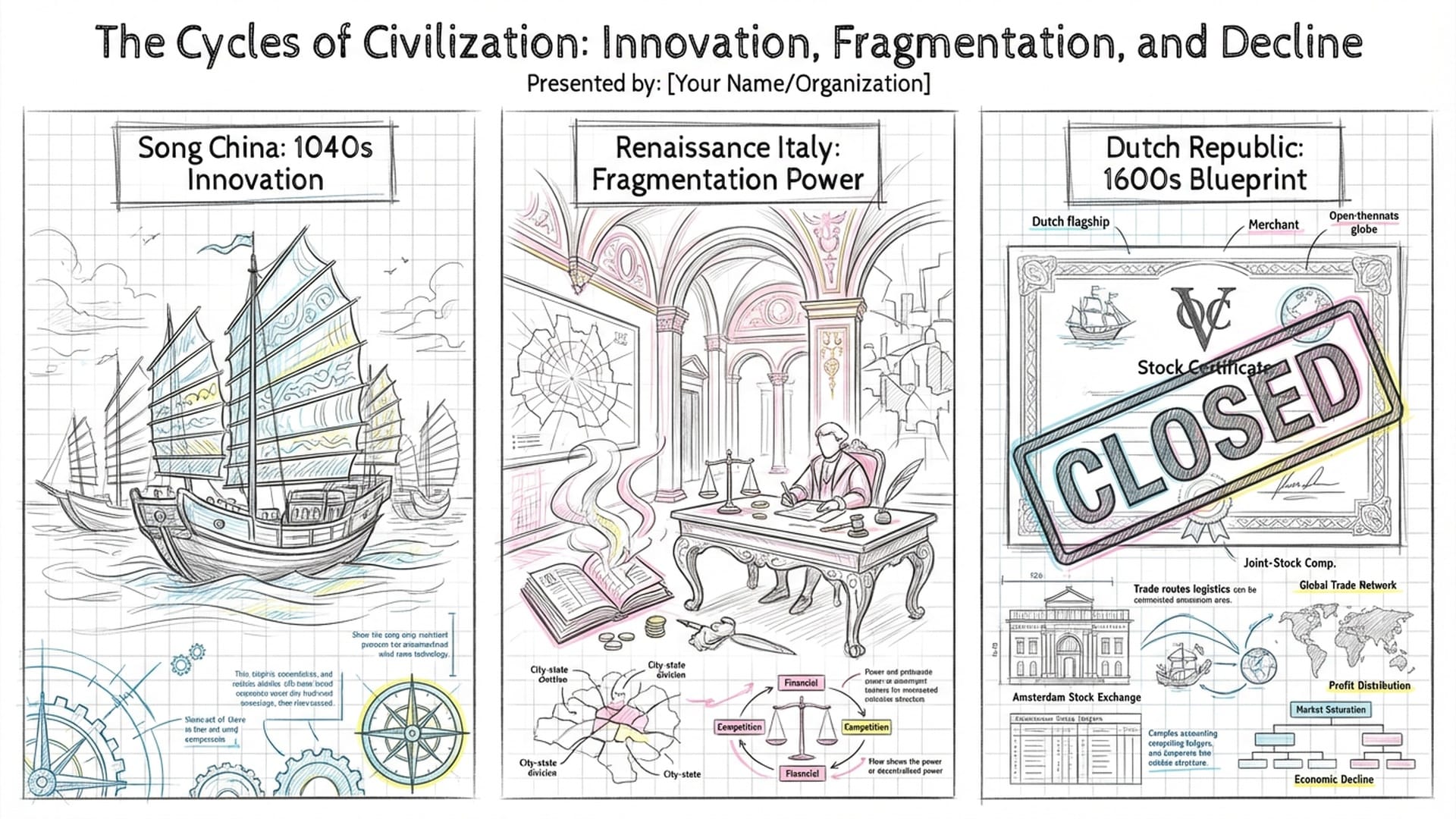
- Song China: The Industrial Revolution That Wasn’t: Norberg identifies Song China as history's great 'what if.' It was an economic powerhouse with a dominant merchant navy, advanced technology like the magnetic compass, and industrial-scale iron smelting. Movable type printing spurred literacy. Yet, the Industrial Revolution occurred in 18th-century Britain, not 11th-century China. Norberg attributes this to the 'Closing.' The state, fearing the disruptive power of merchants, reasserted control. The Confucian bureaucracy, prioritizing stability over mercantile innovation, imposed restrictions that halted crucial 'tinkering.'
- Renaissance Italy: The Power of Fragmentation: The Italian city-states—Florence, Venice, Genoa—illustrate the power of competition and decentralization. The absence of a single sovereign meant that talent could migrate, ensuring rulers remained open. Their sprawling banking networks pioneered financial instruments still used today. Their fall can be attributed to foreign domination, shifting trade routes, and the internal rigidities of guilds and the stifling force of the Counter-Reformation, which policed the 'Open Minds' that produced Da Vinci and Galileo.
- The Dutch Republic: The First Modern Economy: The Dutch Golden Age (1600s) was the blueprint for the modern liberal order. This small nation became the world's warehouse, embracing 'Open Doors' for refugees and thinkers like Descartes and Locke. This influx of human capital, combined with financial innovations like the stock market, generated unprecedented wealth. Its fall came as success bred protectionism. The Dutch regents became a closed oligarchy, and the dynamic merchant economy calcified into a rentier economy, ultimately eclipsed by Britain.
The Anglosphere at a Crossroads: Symptoms of Closure
The latter part of Peak Human focuses on the Anglosphere, particularly the UK and the US, over the last two centuries. Norberg contends this has been the most transformative Golden Age in history, dramatically reducing global poverty and increasing life expectancy. This success was built on a radical expansion of all four pillars: global trade, mass immigration, scientific revolution, and robust rule of law.
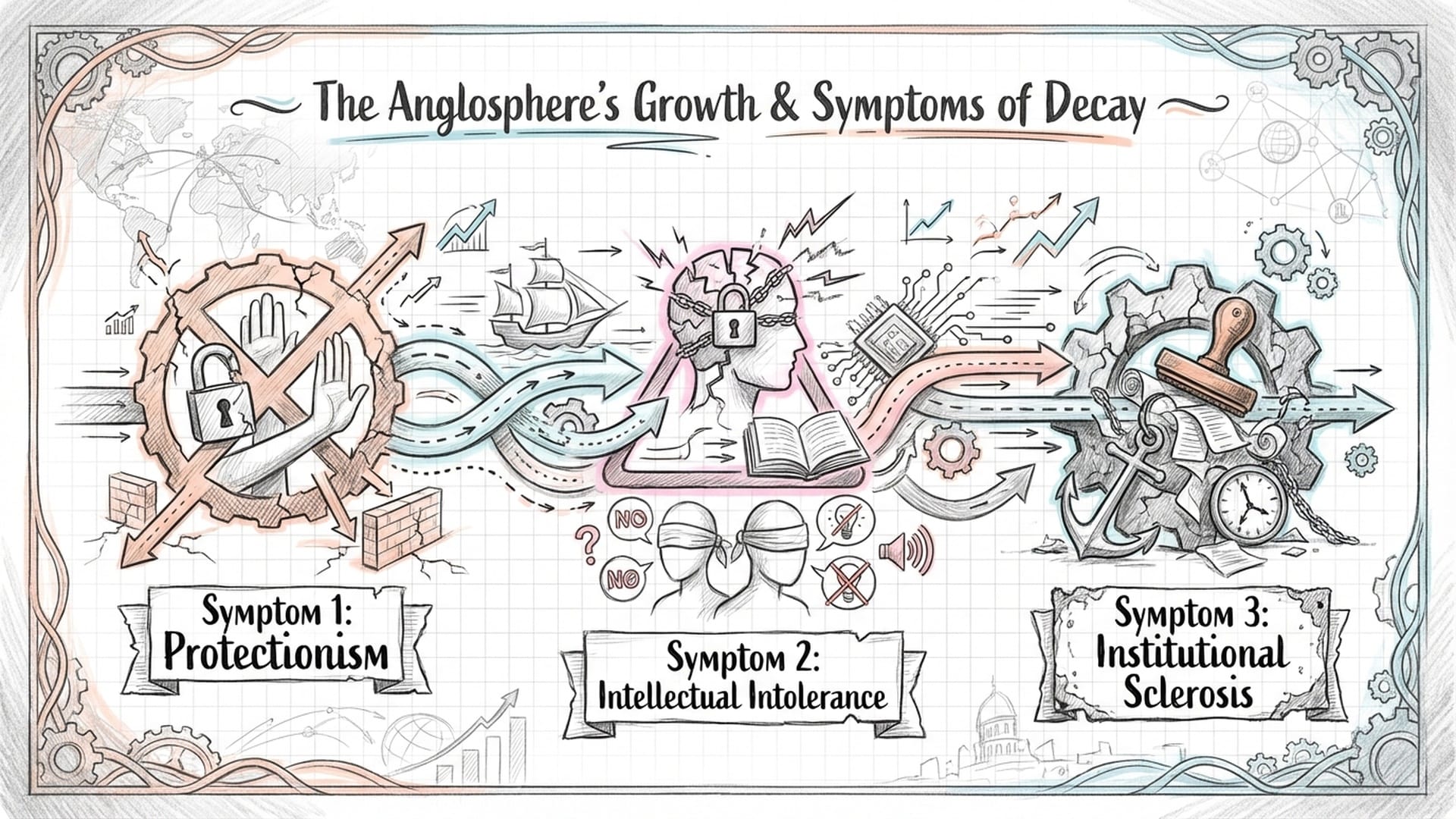
However, Norberg poses the critical question: "How do we ensure that our current golden age doesn't end?" He argues that the Anglosphere is currently exhibiting classic, dangerous symptoms of a civilization preparing to 'close':
- The Return of Protectionism: The consensus on free trade has shattered, with both American political factions embracing tariffs and industrial policy, echoing the errors of Song China and the late Dutch Republic.
- Intellectual Intolerance: The 'Open Mind' is under siege from cancel culture, censorship, and ideological polarization, reminiscent of the closing of the gates of reason in the Abbasid era.
- Institutional Sclerosis: The regulatory state has become so complex and Byzantine that it actively stifles the permissionless innovation vital for progress.
Venezuela: The Nadir of a Closed Society
If the Dutch Republic represented the zenith of openness, Venezuela under Nicolás Maduro, until January 3rd, 2026, exemplified the nadir of a closed society. The US operation to apprehend Maduro offers a visceral, real-time case study validating Norberg’s thesis through the negation of its every principle.
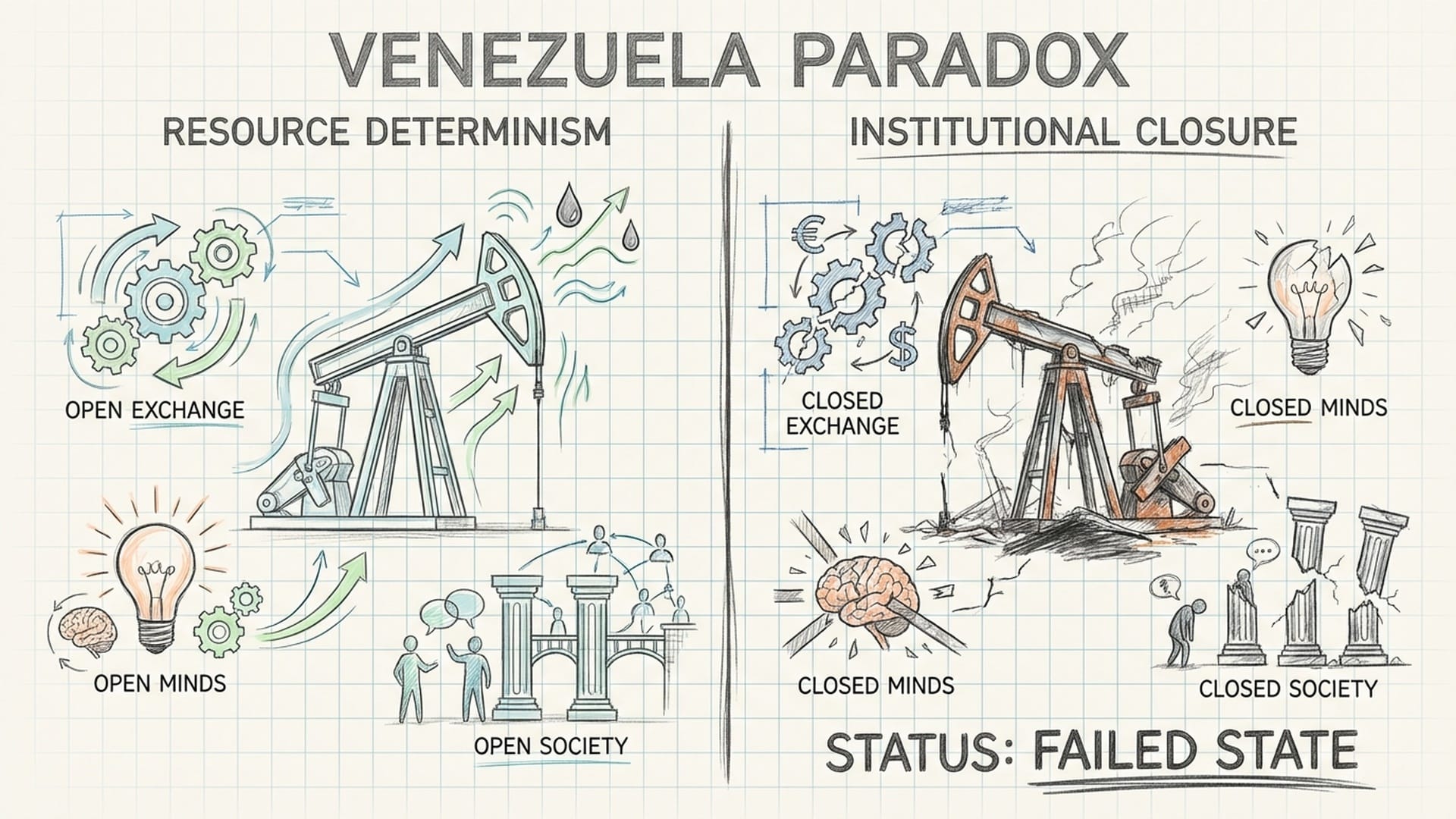
Venezuela, despite possessing the world's largest proven oil reserves, became a pauper state under Chavismo and Maduro. Norberg’s framework explains why with brutal clarity:
- Closed Exchange: Nationalized industries, draconian price controls, and severed ties with the global financial system led to production collapse, hyperinflation, and chronic shortages.
- Closed Minds: Economic expertise was replaced by ideological loyalty, dissent was criminalized, and data suppressed, breaking the 'feedback loop' of reality and leading to unchecked policy errors.
- Closed Society: The rule of law was dismantled, the judiciary became an arm of the executive, and property rights were nonexistent, terrifying capital and halting investment.
The kinetic intervention of January 3, 2026—the arrest of Maduro and his wife on narco-terrorism charges—was a watershed moment. While the outcome (the end of a closed tyranny) aligns with Norberg’s values, the method (unilateral military intervention) risks violating the 'Open Society' principle of international rule of law. Global reactions highlighted the fractured nature of the 2026 world, with some allies supporting the move and others condemning the violation of international law. This divergence starkly reveals the breakdown of a 'Western consensus' on maintaining global order.
The Fragmented World of 2026
Martin Wolf, the Financial Times chief economics commentator, observed that 2026 marks a pivotal year where "globalization is breaking down—and no one's in charge of what comes next." We are seeing a protectionist pivot, with rising trade barriers, disrupted supply chains, and financial market volatility. The US, under Trump 2.0, is now explicitly using tariffs as geopolitical weapons, pushing the nation towards 'stagflation' and risking a vicious cycle of populism and further closure.
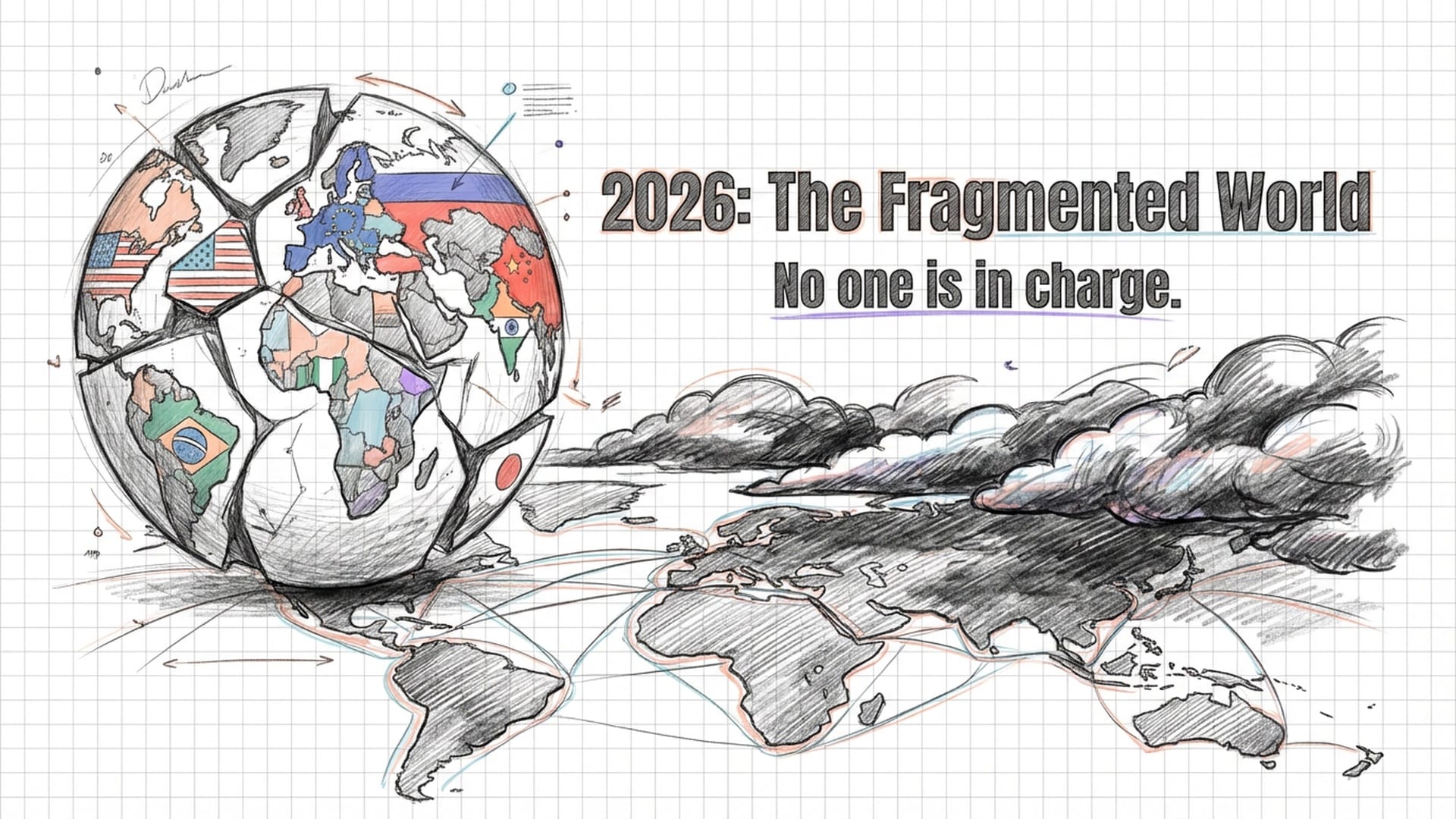
Despite these headlines, global trade hasn't evaporated; it has mutated. Trade volumes remain robust but are rerouting through 'friend-shoring' networks. This resilience underscores humanity's inherent drive to exchange, yet the political barriers impose a significant 'geopolitical tax' on every transaction, dragging down global growth.
The Robotics Flywheel vs. Digital Borders
A critical tension in 2026 lies between the inherent openness of technology and the closing of borders. Norberg’s lesson from Song China is pertinent: technological superiority offers no guarantee if the political system turns against it. The "Robotics Flywheel"—where action generates data, data trains models, and models make robots smarter—exemplifies 'Open Minds' in engineering, driving exponential productivity gains.
However, this flywheel depends on the free flow of data, chips, and talent. The 'Great Closing' threatens to jam it, with nations erecting 'digital borders' that fragment crucial datasets and slow AI progress. Supply chain wars, restrictions on high-end chip exports, and the siloing of scientific research echo the tragic loss of the 'Translation Movement' in the Abbasid era. Norberg's thesis predicts that the civilization that keeps its 'digital borders' most open to global talent and data will win the AI race; those that close off will stagnate.

The Norberg Alpha: A Strategy for Openness
For policymakers, investors, and concerned citizens in 2026, Peak Human offers a clear strategic heuristic: the 'Norberg Alpha.'
- Avoid 'Closed' Jurisdictions: Nations sliding toward autarky, heavy tariffs, or aggressive nativism (like Venezuela) offer historically poor long-term growth prospects.
- Seek 'Connector' Economies: In a fragmented world, 'open' intermediaries (e.g., Vietnam, India, or Anglosphere hubs maintaining relations with multiple blocs) will likely capture outsized value.
- Value Institutional Strength: Invest in regions with robust rule of law. The Anglosphere’s legal stability remains its greatest asset, provided it isn't eroded by political overreach.
The fall of Maduro is a tactical victory for the US, but Peak Human warns against the profound hubris of the victor. If the US adopts the 'closed' habits of its adversaries—rampant protectionism, cronyism, and destructive unilateralism—it risks entering the terminal phase of its own Golden Age.
The lesson of 2026, brought to light by Norberg and reflected in geopolitical turmoil, is crystal clear: the 'Great Closing' is not an inevitable force of nature. It is a choice. To ensure our current Golden Age endures, the Anglosphere must profoundly resist the siren song of perceived safety and stasis. We must confidently remain open—to trade, to ideas, and to the wider world—especially when it feels most vulnerable.
 |  |  |  |