
 |  |  |  |
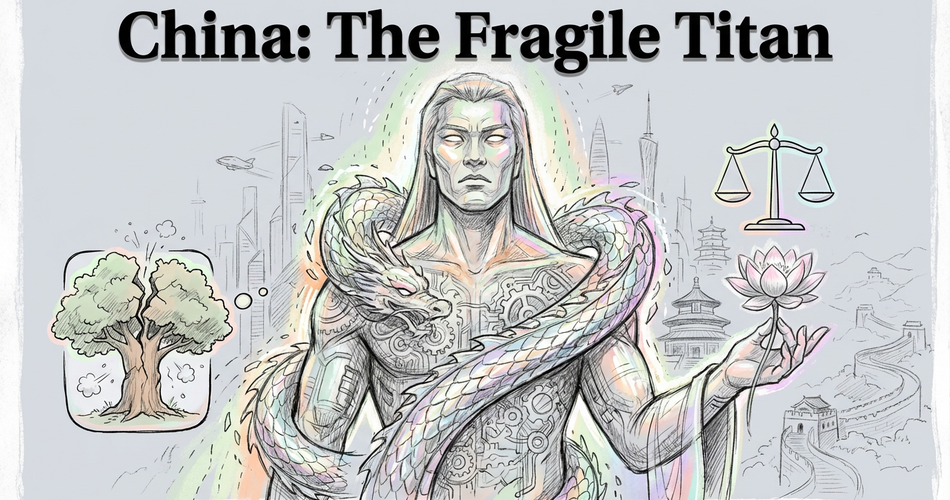
China: The Enduring Paradox of a Partial Superpower
Could the most dominant global power not be the one we all assume? What if its very strengths harbor its gravest weaknesses? We are currently witnessing the emergence of a new kind of superpower – one that is both breathtakingly advanced and startlingly fragile. This is the paradox that is China: a titan with feet of clay, a technological leader grappling with deeply entrenched internal challenges. Understanding this complex reality is no longer optional; it is imperative.
Unprecedented Industrial Might: The Shipyard Narrative
Let's move beyond abstract discussions and examine a tangible demonstration of China's formidable industrial capacity. Imagine a sprawling Chinese shipyard, a vibrant hub of ceaseless activity. Here, cranes taller than skyscrapers meticulously assemble ship sections as vast as city blocks. The air vibrates with the sounds of production: sparks flying, welders blazing, the rhythmic clang of construction. Now, contrast this with shipyards in the West, particularly in the United States, which often appear quieter, older, and less frenetic.
In 2024, a single Chinese conglomerate constructed more commercial vessels by tonnage than the entire U.S. shipbuilding industry had produced in nearly eighty years since World War Two.
This isn't just a stark statistic; it's a profound visual representation of industrial prowess and national will. For decades, the West prioritized 'quality over quantity'. However, China has engineered a gaping chasm in foundational industrial capacity, a gap that has serious implications for geopolitical dynamics.

This industrial base isn't confined to commercial shipping. China's shipyards can rapidly pivot to military production, leveraging the same supply chains and workforce to churn out frigates, destroyers, and amphibious assault ships. Consequently, the Chinese navy commissions new surface combatants at a rate of roughly three-to-one compared to the U.S. Navy. The notion that Chinese naval vessels are merely numerous but inferior is rapidly becoming outdated. Many analysts regard their Type 055 Renhai-class cruiser as arguably the most capable surface combatant globally, significantly narrowing the gap in pure firepower and missile density.
A Growing Nuclear Ambition and Hypersonic Dominance
The narrative of China's military expansion extends far beyond its shipyards. Consider a vast, desolate desert landscape, suddenly punctuated by hundreds of missile silos emerging from the earth. This isn't a scene from a dystopian film; it's a reality. By mid-2024, China possessed over five hundred operational nuclear warheads, with projections indicating a thousand by 2030. They have decisively abandoned their traditional 'minimum deterrence' policy, seemingly transitioning towards a more aggressive launch-on-warning posture.
This rapid nuclear expansion, combined with advanced delivery systems, fundamentally alters the global strategic landscape, demanding a reassessment of deterrence doctrines.
Even more concerning is China's undeniable lead in hypersonic technology. The DF-17, their hypersonic glide vehicle, travels at Mach five-plus, demonstrating unparalleled maneuverability and evasiveness. It effectively renders existing missile defense systems obsolete. In 2024 alone, China conducted more hypersonic test flights than the U.S. has in an entire decade. Leaked wargames from 2024 revealed a sobering scenario: advanced U.S. aircraft carriers, such as the USS Gerald R. Ford, could be neutralized by massed hypersonic barrages before their air wings could even launch over Taiwan. This capability drastically alters the risk calculus for any potential U.S. intervention.

The 'Peace Disease' and Systemic Fragility
Despite this awe-inspiring display of military and industrial strength, there is a profound underlying fragility. All this advanced hardware, all this formidable might, rests on a foundation that is, to put it mildly, precarious. It's akin to building a monstrously powerful computer with expired thermal paste and a secretly compromised cooling system. This hidden decay is encapsulated by what is known as the 'Peace Disease.'
In 2023 and 2024, an intensive anti-corruption campaign swept through the Chinese military. High-ranking officials, including the Defense Minister and commanders of the Rocket Force, were summarily removed. This wasn't merely about personal enrichment; it was corruption that directly impacted combat readiness. Unsubstantiated, yet chilling, rumors circulated about missiles filled with water instead of fuel, and silo lids that failed to function.
This widespread corruption is not a minor oversight; it reveals a systemic rot within the People's Liberation Army (PLA). While the hardware projects superpower status, the software – its logistics, maintenance, and command integrity – remains critically brittle. This 'Peace Disease' fosters significant hesitation within Beijing, raising questions about the true operational capacity of its forces.

Economic Turbulence and the 'New Three' Engine
Beyond the military, a nation's stability is inherently tied to its economy and its people. For two decades, China's economic engine was primarily fueled by real estate, contributing nearly thirty percent of its GDP. For ordinary Chinese families, property ownership was the guaranteed path to wealth, a repository for their life savings, hopes, and dreams. Then, this engine sputtered and ultimately collapsed. Seventy percent of Chinese household wealth was locked into property, and now, prices have plummeted 10-20% in many cities, creating a massive negative wealth effect. Local governments, too, are burdened by an estimated $8.3 trillion in 'hidden debt', according to the IMF.
Many prognosticated a full-blown economic collapse. However, China displayed an unexpected resilience, executing a dramatic pivot. They aggressively championed the 'New Productive Forces,' focusing specifically on the 'New Three':
- Electric Vehicles (EVs)
- Lithium-ion Batteries
- Solar Products
This sector became a lifeline, contributing ten percent to China's GDP and driving forty percent of its economic growth in 2024. This rapid transformation virtually single-handedly averted an economic recession, solidifying China's dominance in the global supply chain for these critical technologies.

Geopolitical Friction: Overcapacity and Trade Wars
The success of the 'New Three' has, however, created a new set of challenges. China's efficiency and scale have led to overcapacity, with domestic demand unable to absorb the sheer volume of production. This results in persistent factory gate deflation, with producer prices falling for over 38 consecutive months. To mitigate this, China is flooding global markets with cheap, high-tech goods, sparking a geopolitical earthquake.
The U.S. and EU are responding with tariffs, framing Chinese EVs and batteries not merely as competitive threats, but as security risks. This "securitization of trade" aims to restrict China's ability to export its way out of its economic woes, creating a messy and unpredictable global trade environment.
A Fraying Social Contract and the 'Run' Movement
The bedrock of China's social stability has long been a "prosperity-for-acquiescence" contract: the Party delivers economic growth and upward mobility in exchange for political compliance. Yet, this bargain is now fraying. Youth unemployment is alarmingly high and structural. Middle-class citizens are witnessing their housing investments vanish. The result? A noticeable rise in dissent events, as reported by independent monitors.
This growing disillusionment has manifested in the 'Run' movement (Runxue). This phenomenon describes a deep-seated pessimism about the future, driven by frustrations with authoritarian rule (epitomized by the Zero-COVID years, which starkly illustrated the lack of individual control). Educated professionals, small business owners, and members of the middle class are now undertaking perilous journeys through places like the Darien Gap, risking everything to reach the U.S. border. The very existence of such a movement, despite the immense risks and costs, speaks volumes about a deep, structural pessimism within society.
The 'Run' movement signifies more than just individual flights; it is a collective expression of a people losing faith in the fundamental promise of their government.
To counter this unrest, Xi Jinping has revived and modernized the Maoist 'Fengqiao Experience,' transforming it into a high-tech surveillance state. This 'Fengqiao Experience 2.0' employs a high-tech panopticon, utilizing grid management of cities, pervasive facial recognition, and big data analytics. The objective is to resolve 'contradictions' at the local level and atomize dissent, preventing any large-scale organization or protest. This system is efficient, terrifying, and currently, quite effective.

China: A Partial Superpower
How, then, do we classify this complex nation? From a purely realist perspective, China is undoubtedly a regional hegemon. It has successfully pushed back the U.S. security perimeter in Asia. However, it still lacks two critical characteristics of a true global superpower:
- Global force projection
- A network of committed military allies
From a liberal perspective focusing on soft power, China also falls short. Its "wolf warrior" diplomacy and alliances with Russia have alienated many in Europe and North America. While it retains influence as a development partner in the Global South, this doesn't translate into universal appeal.
Therefore, the most accurate classification appears to be a Partial Superpower. China wields immense economic weight and regional military dominance, but it lacks the full global military reach, the robust alliance network, and the widespread soft power appeal necessary to achieve full parity with the United States.

Navigating the Future: Key Implications
Understanding this nuanced reality necessitates a shift in our own strategic thinking:
- Do not underestimate China's resilience. Narratives predicting China's 'inevitable collapse' are not only simplistic but dangerous. Its industrial base is robust, and its state can mobilize resources for strategic objectives with incredible efficiency, as demonstrated by its green technology pivot. This is not a nation on the brink of implosion, but one constantly adapting and asserting its power in new ways.
- Prepare for export shocks. China's manufacturing overcapacity is a persistent reality. It will continue to drive down global goods prices, exerting significant pressure on Western industries. Expect an influx of cheap, high-tech products. This isn't a mere economic footnote; it represents a fundamental shift in global trade dynamics that will reshape industries and consumer markets worldwide, demanding significant adaptation.
- Watch the 'Peace Disease' carefully. The corruption within the PLA presents a double-edged sword. On one hand, it might deter kinetic action against Taiwan, as Beijing may lack full trust in its own systems' readiness. On the other hand, it increases the risk of accidental escalation, as inexperienced commanders might mishandle complex, potentially faulty equipment in a tense region. This creates both a hesitant hand and an unpredictable risk.
The China of 2025 is a formidable yet brittle giant. It commands hypersonic wealth and world-leading factories, yet it grapples with deep anxieties about its own populace, led by a party obsessed with control. It is neither a clear-cut enemy nor a predictable friend; rather, it is something entirely new—a complex entity demanding our sustained and nuanced attention.
 |  |  |