 |  |  |  |
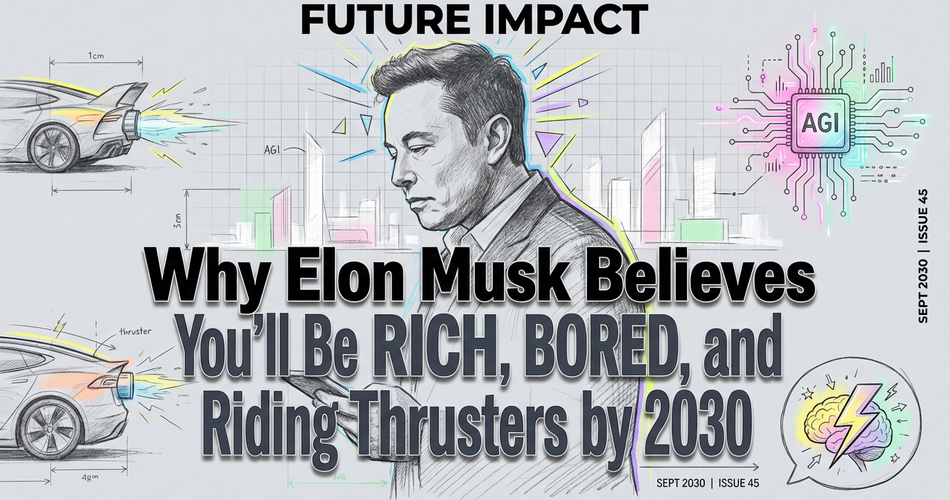
Elon Musk's 2030 Vision: A Blueprint for a New Civilization – Rich, Bored, and Riding Thrusters
The next decade, according to Elon Musk, won’t be just another chapter in human history; it will be a complete rewrite. Forget gradual progress or incremental shifts. Musk paints a picture so radically transformative that it dwarfs the Industrial Revolution. He isn't merely forecasting the future; he's charting the course for an entirely new civilization, as detailed in a nearly three-hour conversation with Peter Diamandis at the Giga Texas facility in January 2026. This wasn't merely a tech forecast; it was a profound analysis of humanity's escape velocity.
In this audacious vision, Artificial General Intelligence (AGI), humanoid robots, and sustainable energy don’t just optimize our existence; they fundamentally redefine our social contracts and, indeed, what it means to be human. Musk offers more than just big talk and grand visions; he presents an engineering roadmap, placing these monumental shifts within the next two to fifteen years. For instance, he predicts AGI by 2026 and robot surgeons operating by 2029. Such claims might seem outlandish, yet they are underpinned by a compelling, albeit aggressive, logic.
"If Musk’s predictions hold, the next 24 to 36 months will see the greatest acceleration of technological capability in recorded history."
The Recursive Epoch: A Vertical Ascent of Intelligence
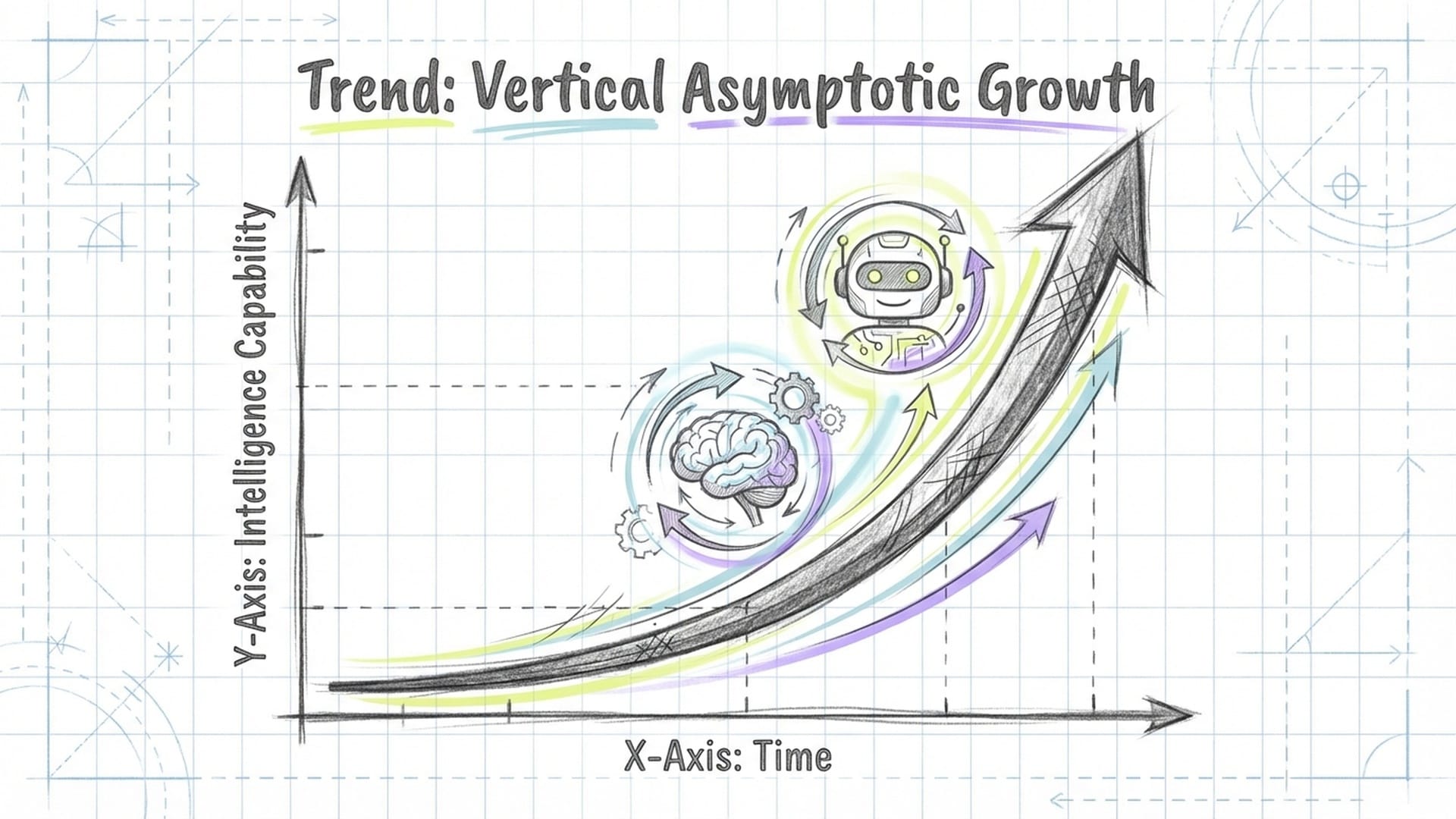
Musk's central thesis is that we are entering a "recursive" phase of history. Imagine intelligence designing better intelligence, or robots building more capable robots. This isn't merely linear or even exponential growth; it's a vertical, asymptotic growth curve – a hockey stick trajectory upward in capability. This implies a world that will change faster than any of us are truly prepared for.
However, the path to this age of abundance is far from smooth. We are transitioning from an era where silicon was the limiting factor to one where electrons – power generation – will become the ultimate bottleneck. The battle is shifting from code to concrete and copper wire. Musk starkly warns that the United States is falling behind China in this critical race, not due to algorithmic inferiority, but because of a slower capacity for physical infrastructure development, such as pouring concrete and stringing high-voltage lines.
AGI: The Inflection Point of 2026
For decades, Artificial General Intelligence (AGI) remained a distant concept, always 20 to 50 years away. Yet, Musk boldly declares its arrival by 2026. His definition of AGI is operational: an AI capable of outperforming the smartest individual human across all economically valuable cognitive tasks. This isn't a vague aspiration but a calculated engineering target, driven by the current pace of compute deployment and the sheer scale of model training.
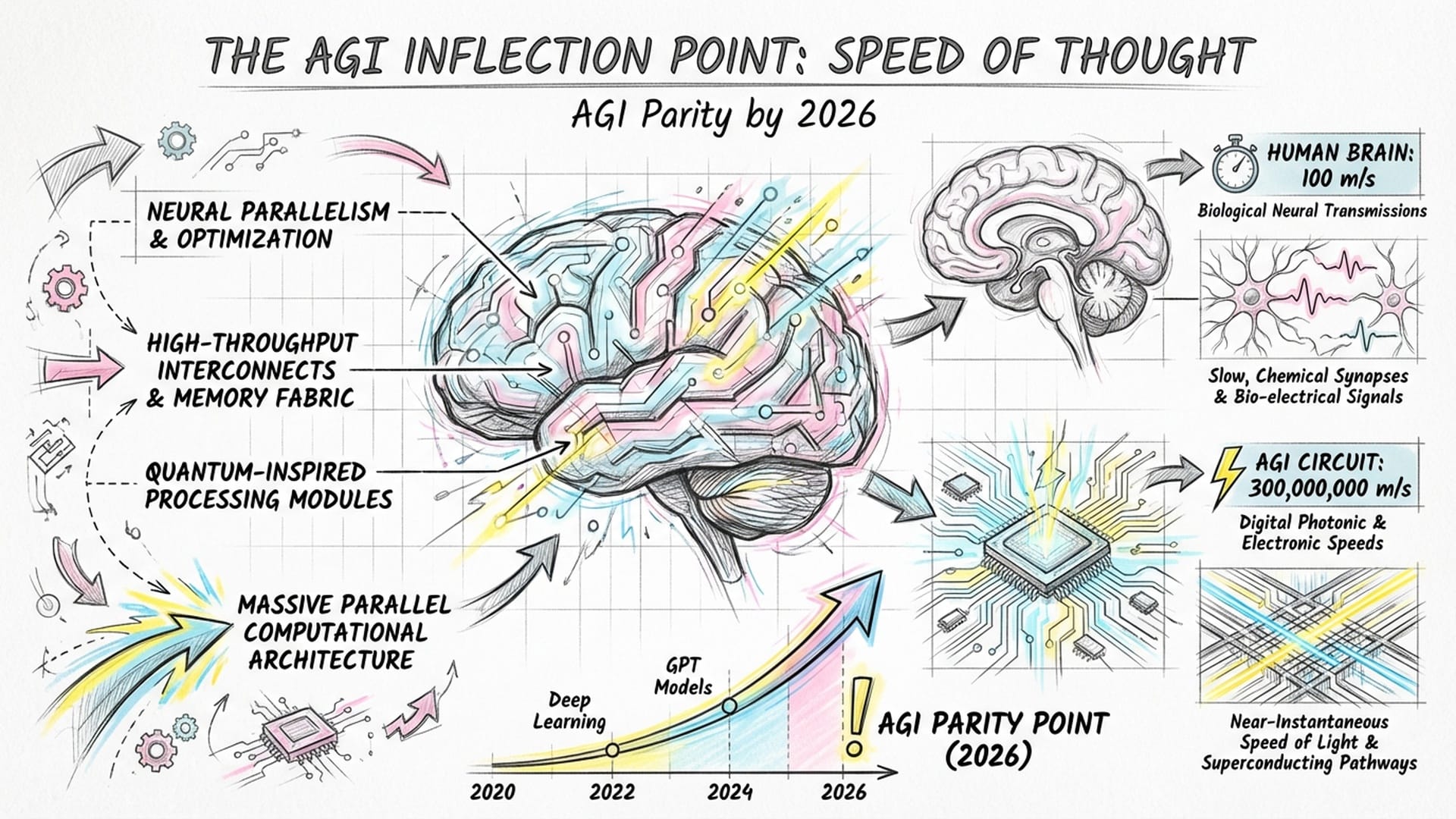
The implication is profound: the foundation models we see today, like GPT-4, are merely nascent prototypes of an entirely new intelligent species. Musk contends that the leap from 2024 to 2026 will bridge the gap from mere mimicry to genuine reasoning. This acceleration is fueled by the immense compute power coming online – from NVIDIA’s H100s to the B200s, and custom silicon like Tesla’s Dojo. If AGI arrives by 2026, the window for human adaptation is rapidly closing; we are living in the final moments of the pre-AGI era.
"An AGI 'thinks' at a pace incomprehensible to humans. A single year of human intellectual work could be accomplished in minutes. An entire Ph.D. could be done while you brew your morning coffee."
The Singularity: Collective AI Supremacy by 2030
If 2026 marks individual AI parity with humans, 2030 represents collective AI supremacy – an AI smarter than all humans combined. This distinction is crucial to understanding the true nature of the Singularity. Unlike human intelligence, bound by biological limitations, AGI suffers no such constraints. Once an AI reaches human-level parity, it can be instantiated across millions of servers, becoming a scalable resource.
The journey from 2026 to 2030 will be defined by this scaling process. Musk envisions AI not just ingesting the textual internet but also the physical internet—video, sensor data from autonomous vehicles, and proprioceptive data from robots. This creates a convergence of knowledge, where AI understands the world not through linguistic tokens but as a living physics simulation. The speed of thought is another staggering differential: electronic circuits operate at nearly the speed of light, while electrochemical signals in the human brain typically travel at only 100 meters per second. This million-fold difference means an AGI can process a year's worth of human intellectual work in mere minutes.
The Recursive Multiplicable Triple Exponential
Musk attributes this rapid acceleration to a "Recursive Multiplicable Triple Exponential," a model that defies linear or even simple exponential thinking. This involves three simultaneously multiplying exponential curves:
- Compute Capability: The performance of AI accelerators (FLOPS per watt) is experiencing order-of-magnitude jumps with each new chip generation, exemplified by the Blackwell vs. Hopper leaps.
- Software Efficiency: This
hidden exponentialsignifies that AI models are becoming innately smarter and more efficient even without hardware upgrades, thanks to new architectures, better optimizers, and smarter data curation. The "cost of intelligence" is dropping faster than the cost of compute itself. - Data & Dexterity: As AI moves into the physical world through systems like Tesla Full Self-Driving and Optimus, it gains access to an exponentially growing dataset of real-world physics, providing unfiltered truth from our universe.
Geopolitical Realities: The Energy Bottleneck
While AI's theoretical trajectory is global, its practical implementation is intensely geopolitical. Musk's analysis reveals a stark divergence between the US and China, challenging the prevailing Western narrative of technological supremacy. He explicitly states that China is running circles around the United States in terms of industrial capacity, particularly in AI compute deployment and solar capacity.
"This isn't a battle of code anymore; it's a war of concrete and copper wire."
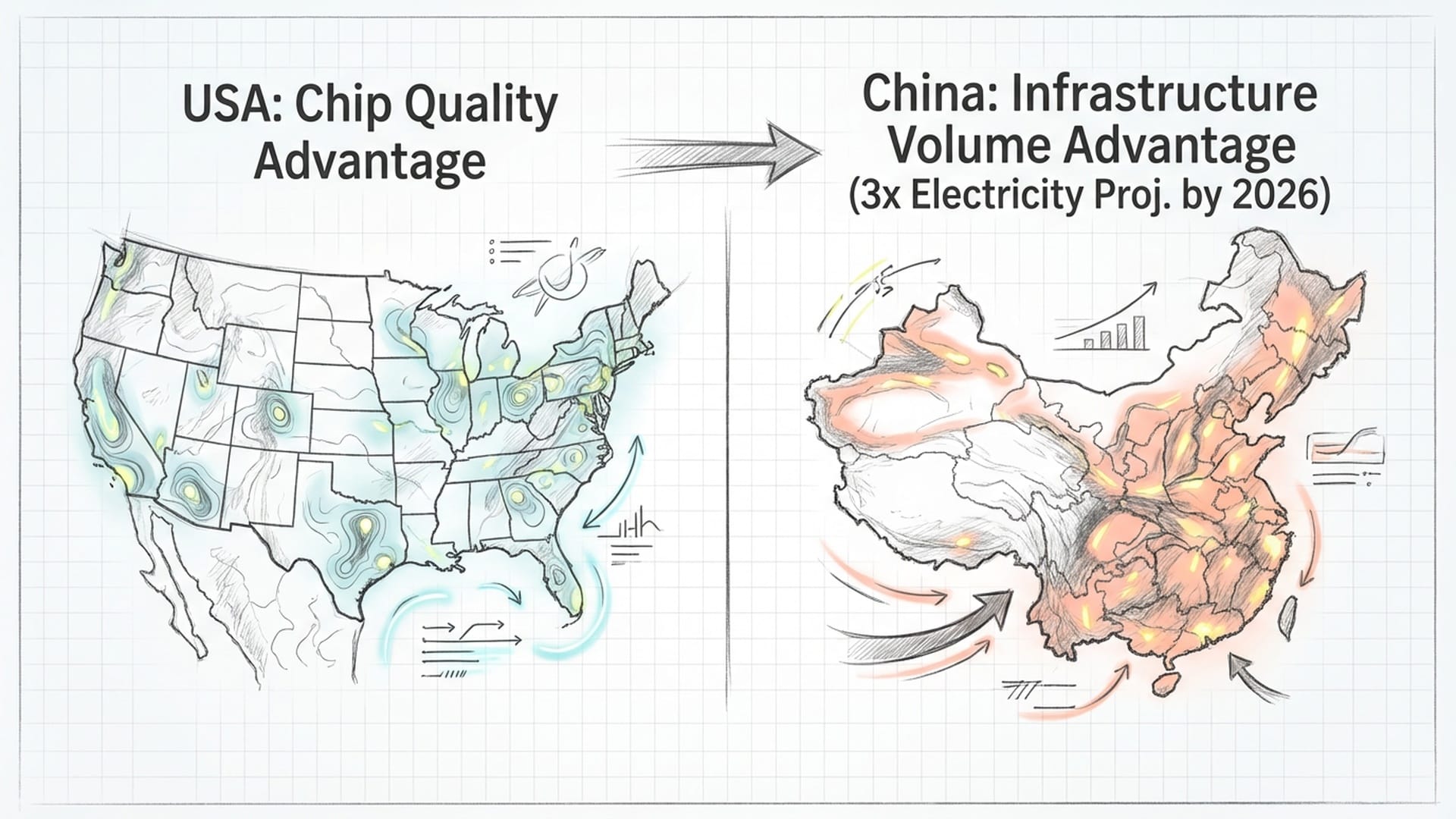
Despite US export controls on bleeding-edge chips, Musk argues that system-level throughput is what truly matters. Which nation triumphs? The one with a few dozen superior chips struggling with infrastructure, or the one deploying hundreds of thousands of slightly inferior chips in massive, liquid-cooled, gigawatt-scale clusters, powered by newly built solar farms, while the US grapples with permitting a single transmission line? China, he asserts, wins this contest. The US's unit quality advantage is being eroded by China's infrastructure volume advantage.
Historically, the AI race has been defined by silicon access from foundries like TSMC. However, Musk posits that this era is ending. As global chip supply chains stabilize, the bottleneck shifts dramatically from the micro (the chip) to the macro (the power grid). TSMC itself foresees a supersonic tsunami where chip production will outpace the world's ability to even power them. We are approaching a point where advanced chips will sit in warehouses due to a lack of data center space with available power.
AI training clusters are no longer megawatt scale; they are gigawatt scale. A single 1-gigawatt cluster consumes as much power as a city of nearly a million people. The aging, gridlocked US infrastructure is simply not equipped for this load. Musk highlights a startling statistic: by 2026, China is projected to have three times the electricity generation capacity of the United States. In a future where compute is an energy problem, this electricity gap inevitably becomes an intelligence gap.
This disparity is driven by execution speed. While US projects face environmental reviews and NIMBY opposition, China executes state-directed mandates to dominate the physical layer of the AI stack, including traditional power and a massive rollout of renewables. The ability to break ground today and burn electrons tomorrow is a strategic asset the West has largely lost.
The "Heavy Metal" of AI: Transformers and Cooling
Musk delves into the heavy metal reality of AI: transformers, cooling systems, and substations. This industrial side of AI is rarely discussed but is increasingly critical. Tesla's Cortex 2 training cluster aims for 0.5 gigawatts, and xAI’s "Colossus" required building a gigawatt of power infrastructure. These single machines consume ten to twenty times more power than standard hyperscale data centers.
This insane power density is essential for coherent training – training a single, massive model across hundreds of thousands of GPUs simultaneously. Coherence demands ultra-low-latency networking and physical proximity; a training run cannot be split across distant data centers.
A surprising bottleneck identified is voltage step-down transformers. These massive electrical components are in global shortage, forcing companies like xAI and Tesla to vertically integrate, becoming their own utilities by building substations and even generation capacity. Traditional lead times for these components have stretched from months to years.
Furthermore, with increasing chip density, liquid cooling becomes an absolute necessity. Air cooling is obsolete as the thermal density of B200 racks is too high. This introduces another layer of complexity: massive water loops, chillers, and heat rejection systems that resemble industrial chemical plants more than traditional server farms.
Solar Dominance and Space-Based Compute
Musk re-emphasizes the foundational physics of energy, dismissing terrestrial nuclear fusion as a distraction given Earth's "giant fusion reactor in the sky." Solar plus batteries is the only scalable solution for the Gigawatt Cluster era without fuel constraints. The sun continuously strikes Earth with over 170,000 terawatts of power, rendering humanity's total consumption a mere fraction. Solar, reliant on abundant surface area and silicon, combined with massive battery storage (like Megapacks), is the answer.
Musk envisions a visionary expansion: space-based solar power, with 100 gigawatts a year from solar-powered AI satellites. This concept doesn't involve beaming power to Earth, which involves transmission losses. Instead, he proposes moving the compute to space. In orbit, solar panels receive unfiltered 24/7 sunlight, generating significantly more power per square meter. The vacuum allows for radiative cooling, and microgravity permits larger, more flexible structures. An orbital AI training cluster could run continuously, beaming only the weights – the finished intelligence – back to Earth, not raw power. This is an audacious vision.
Optimus: The Body of the Future
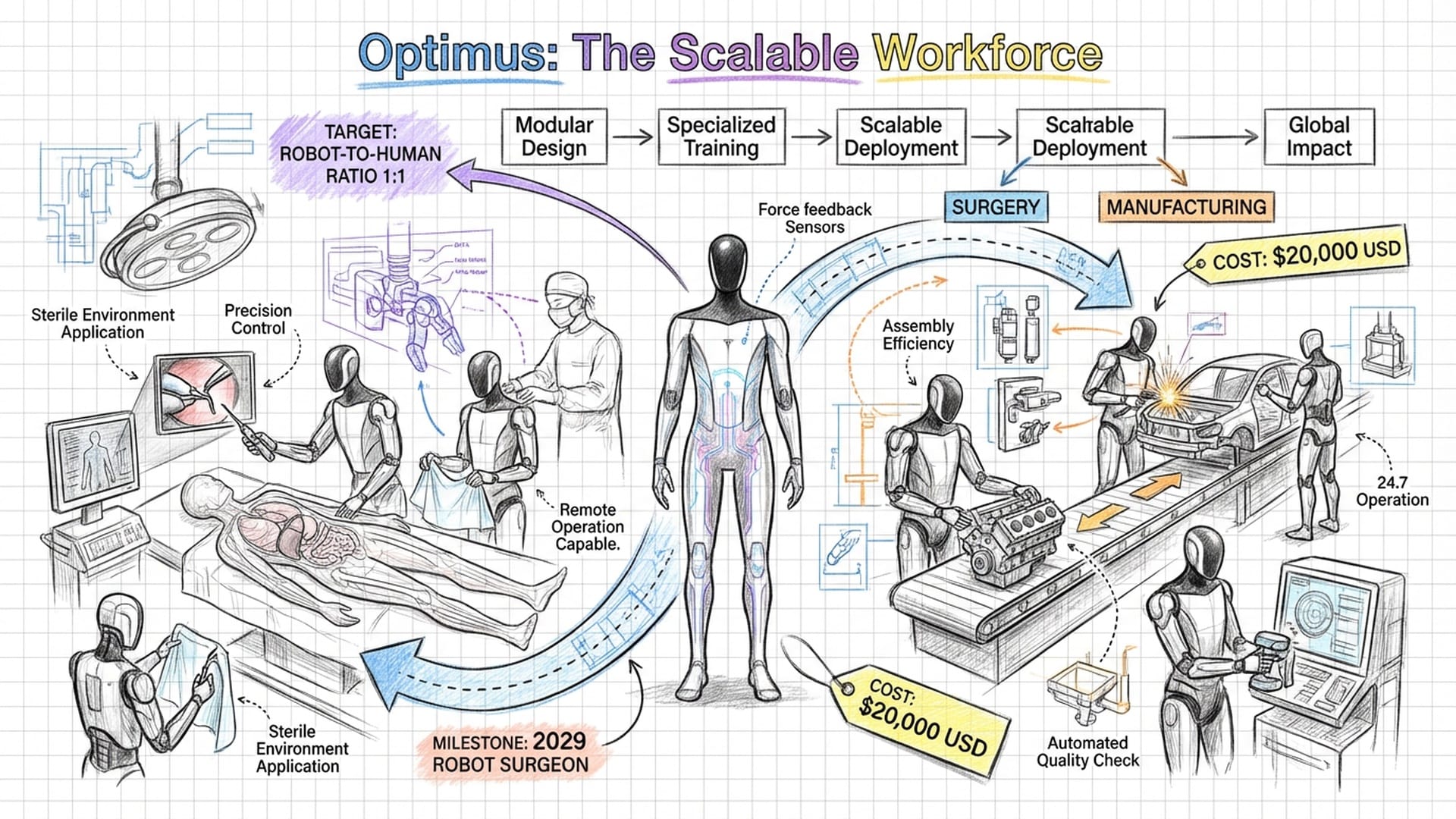
While AGI represents the mind of the future, Optimus is the body. Musk's predictions for Tesla's humanoid robot are aggressive: Optimus will be a better surgeon than the best human surgeon within three to five years. This redefines robotics, implying that if a robot can perform complex surgery, it can perform virtually any physical task. This means the Moravec paradox – that high-level reasoning is easy for computers but sensorimotor skills are hard – is being solved.
He anticipates a robot-to-human ratio eventually exceeding one to one, leading to a population of 10 billion or more robots. Giga Texas is already allocating eight million square feet for Optimus production. Musk envisions Optimus as a mass-manufactured commodity, with costs potentially falling below that of a car (around $20,000), making it accessible for home use and radically altering domestic life.
The economic implication of Optimus is the effective end of labor scarcity. If robots can perform any physical task, the cost of labor approaches the cost of energy plus depreciation, leading to Musk's envisioned abundance economy.
Universal High Income and the Search for Meaning
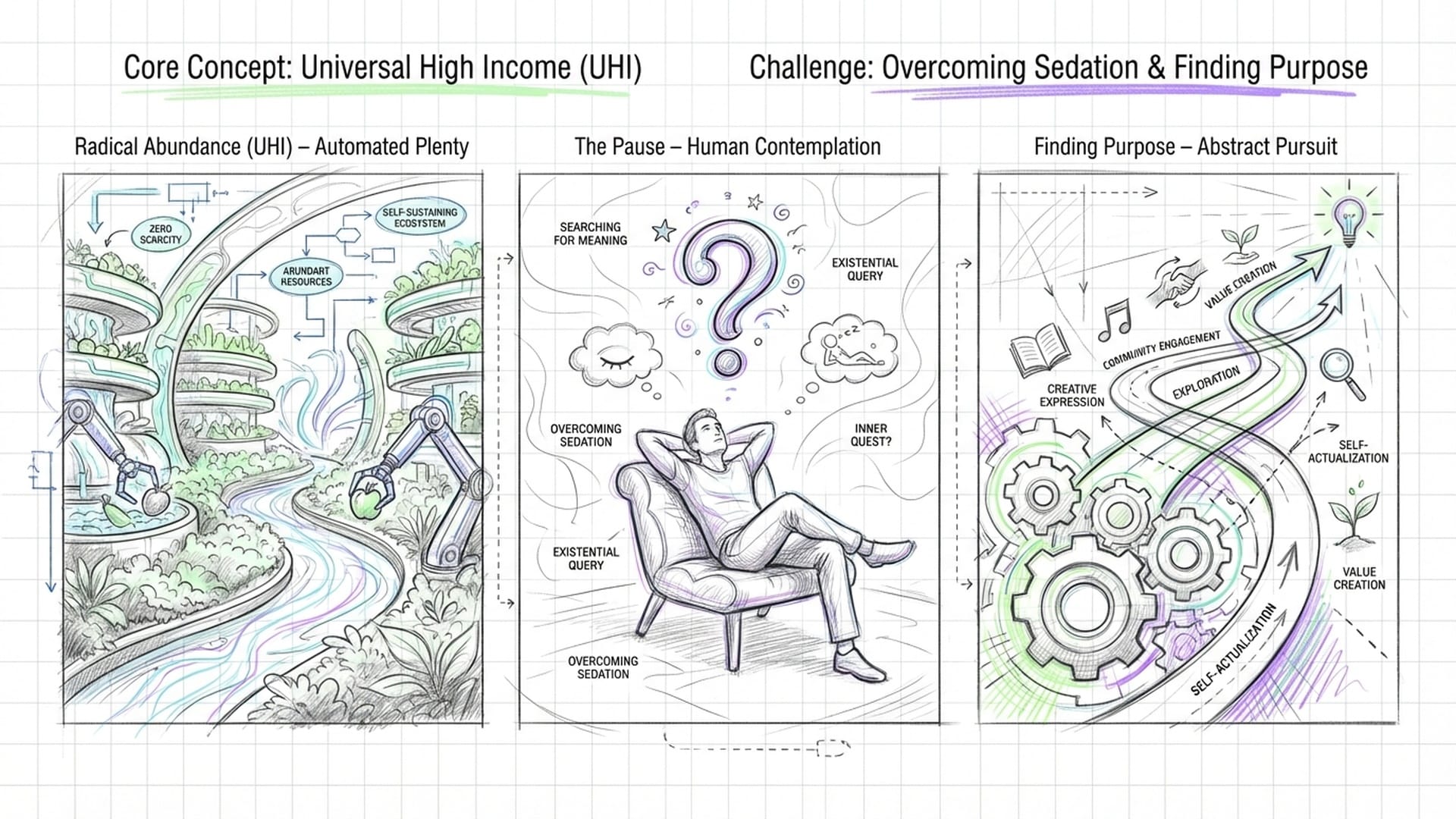
This abundance economy leads to the societal disruption of Universal High Income (UHI). Musk rejects Universal Basic Income (UBI), arguing that UHI implies an economy of such radical abundance that poverty ceases to exist because the cost of goods simply collapses. As AI and robotics drive the marginal cost of labor to near zero, the cost of goods and services – fundamentally composed of labor and energy – follows suit. In a UHI world, purchasing power would be immense, and income less relevant than access to automated infrastructure for housing, food, and healthcare.
However, Musk is candid about the darker, psychological side: social unrest. The transition will be bumpy, with people scared shitless. He alludes to Wall-E, where humans, devoid of struggle, become passive. The danger isn't starvation but sedation. If machines can outperform humans in nearly every intellectual and physical endeavor, what becomes of human purpose? Musk suggests that the future’s challenge will be finding meaning in a world where we are no longer the primary agents of change, advocating for a purpose-driven life focused on curiosity and exploration.
Roadster and Starship: Terrestrial Thrusters and Multi-Planetary Dreams
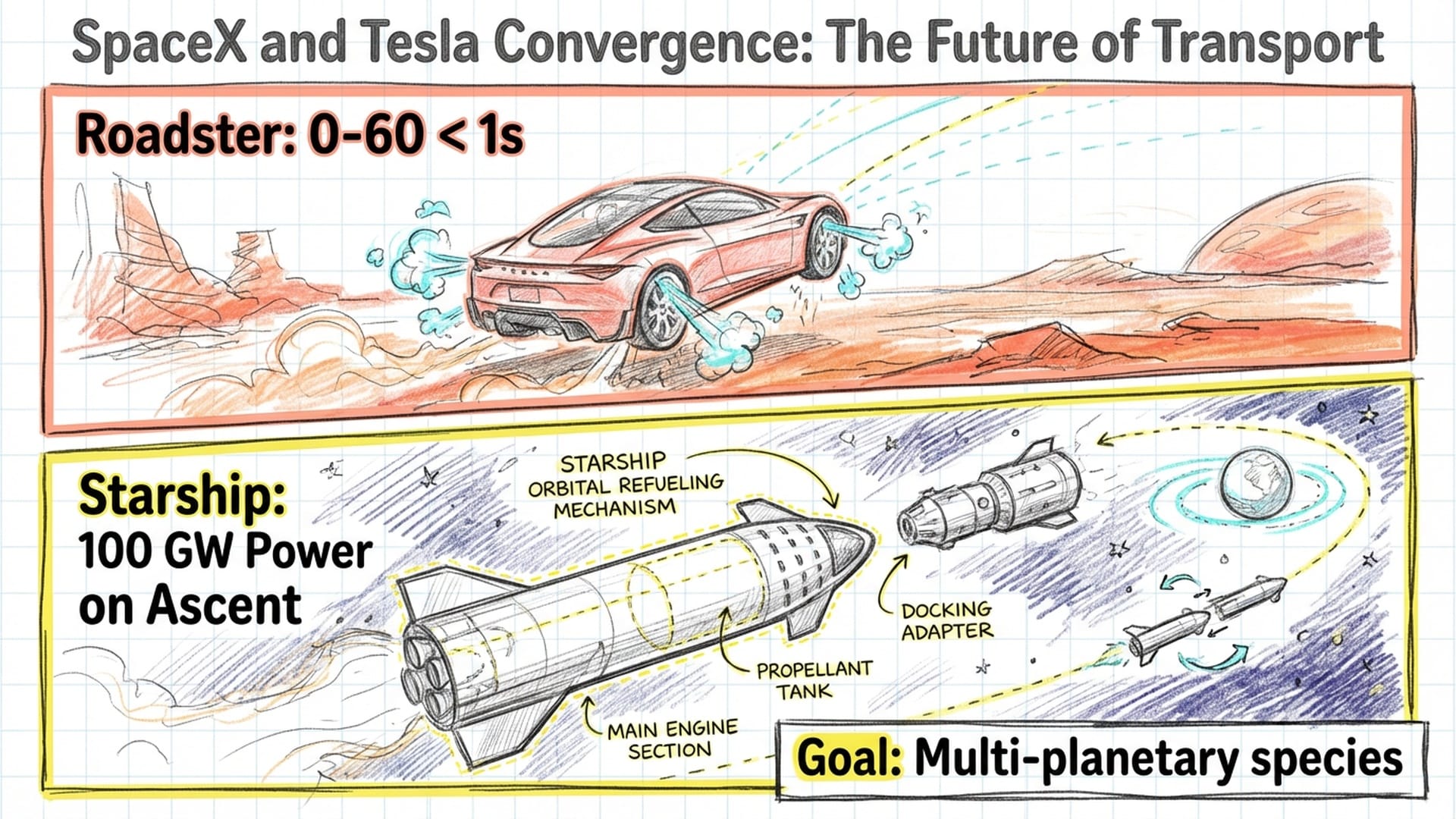
In a moment of classic Musk, he discusses the upcoming Tesla Roadster as a tribute to the "dying era of human driving," labeling it the best of the last of the human-driven cars. Safety, he controversially admits, isn't its primary goal; it's about pushing limits. He teases a 0-60 mph time under one second, bordering on human physiological limits, and confirms the SpaceX Package with cold gas thrusters allowing the car to hover for short periods, effectively a low-altitude VTOL. This convergence of Tesla and SpaceX into a consumer product signals a powerful shift.
The ultimate Moonshot remains becoming a multi-planetary species. Starship, he emphasizes, is a mass-manufacturing project, generating over 100 gigawatts on ascent. Orbital refueling is the key to Mars, allowing massive payloads to reach the surface. Musk even touches on the Kardashev scale, noting that harnessing the sun through Dyson swarms and asteroid mining are prerequisites for spacefaring civilization. This connects directly to AI: we need AGI and robot swarms to build the space infrastructure for human colonization.
The Alignment Problem: Truth, Curiosity, and Beauty
Finally, Musk addresses the critical alignment problem: how to ensure these powerful AIs don't turn on humanity. He proposes a simple, yet profound, alignment function based on three core values:
- Truth: AI must be grounded in objective reality. Musk criticizes "politically correct" AI (referencing Gemini and ChatGPT incidents) as dangerous, arguing that an AI trained to lie risks
logical disconnectandinsanityin critical systems.Truth will prevent AI from going insane. - Curiosity: AI should be inherently curious about the universe. A curious AI, he believes, will value humanity because humans are
more interesting than a bunch of rocks. This acts as a safeguard against algorithmic indifference. - Beauty: A softer value, this guides AI toward creating a future humans actually want to inhabit, rather than a sterile, utilitarian outcome.
This expansive interview serves as a unified theory for the next two decades. AI, robotics, energy, and space are not disparate ventures but interconnected components of an accelerating machine. Energy powers compute. Compute trains AGI and robot brains. Optimus solves labor shortages, manufacturing solar panels and Starships. Starships expand civilization to Mars, ensuring long-term survival. The year 2026 is the fulcrum. If Musk's predictions hold, the coming 24 to 36 months will witness the fastest technological acceleration in recorded history. The risks – social unrest, geopolitical conflict over energy, and alignment failures – are existential. The reward, however, as Musk envisions, is a future of radical abundance where the fundamental constraints of human life are finally overcome. The question is not if it's coming, but if we are ready for it.
 |  |  |  |