
 |  |  |
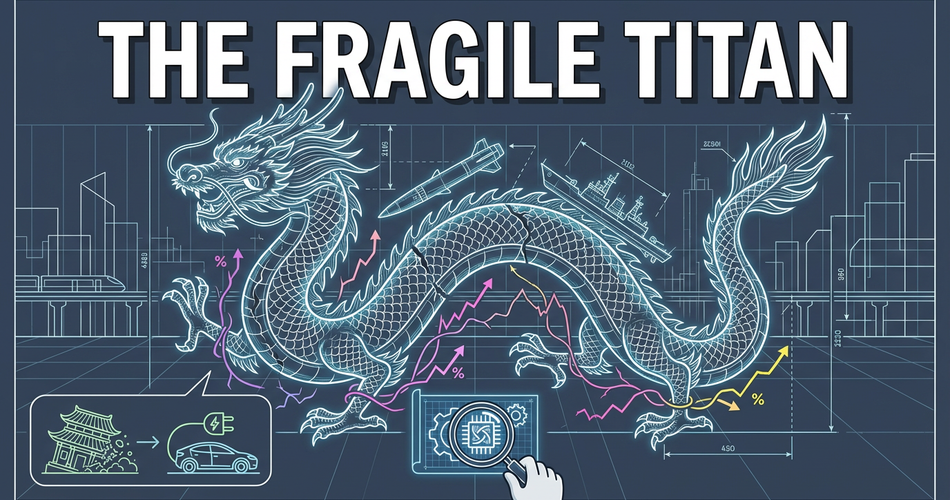
China in the mid-2020s stands at a pivotal historical crossroads, embodying a nation of staggering contradictions. Once roaring with high-speed growth, it is now navigating a treacherous path towards high-quality development and comprehensive national security. This transformation poses a critical question: what does this evolution truly signify for both China and the global landscape?
The People's Liberation Army: Power vs. Pathology
The People’s Liberation Army (PLA) has achieved remarkable breakthroughs in certain areas. Its naval shipbuilding capacity is astonishing, illustrating a monumental hard power accumulation. Furthermore, China's hypersonic delivery systems arguably surpass those of the United States in specific regional denial capabilities within the First Island Chain.

However, this immense power is shadowed by deep-seated institutional corruption. The purges within the Rocket Force in 2023 and 2024 sent shockwaves, casting significant doubt on the PLA’s actual combat readiness. Are these shining new weapons systems truly backed by competent, uncorrupted operational integrity? The answer remains uncertain.
"This immense power is shadowed by deep-seated institutional corruption. The purges in 2023 and 2024, particularly within the Rocket Force, sent shockwaves. They cast a real doubt on the PLA’s actual combat readiness."
Economy: An Engine Replaced
China's traditional growth engine, the real estate sector, has not merely slowed but has, in many aspects, collapsed. This collapse has evaporated trillions in household wealth, triggering persistent deflationary pressures. While some might interpret this as China's economic demise, such a narrative is premature.
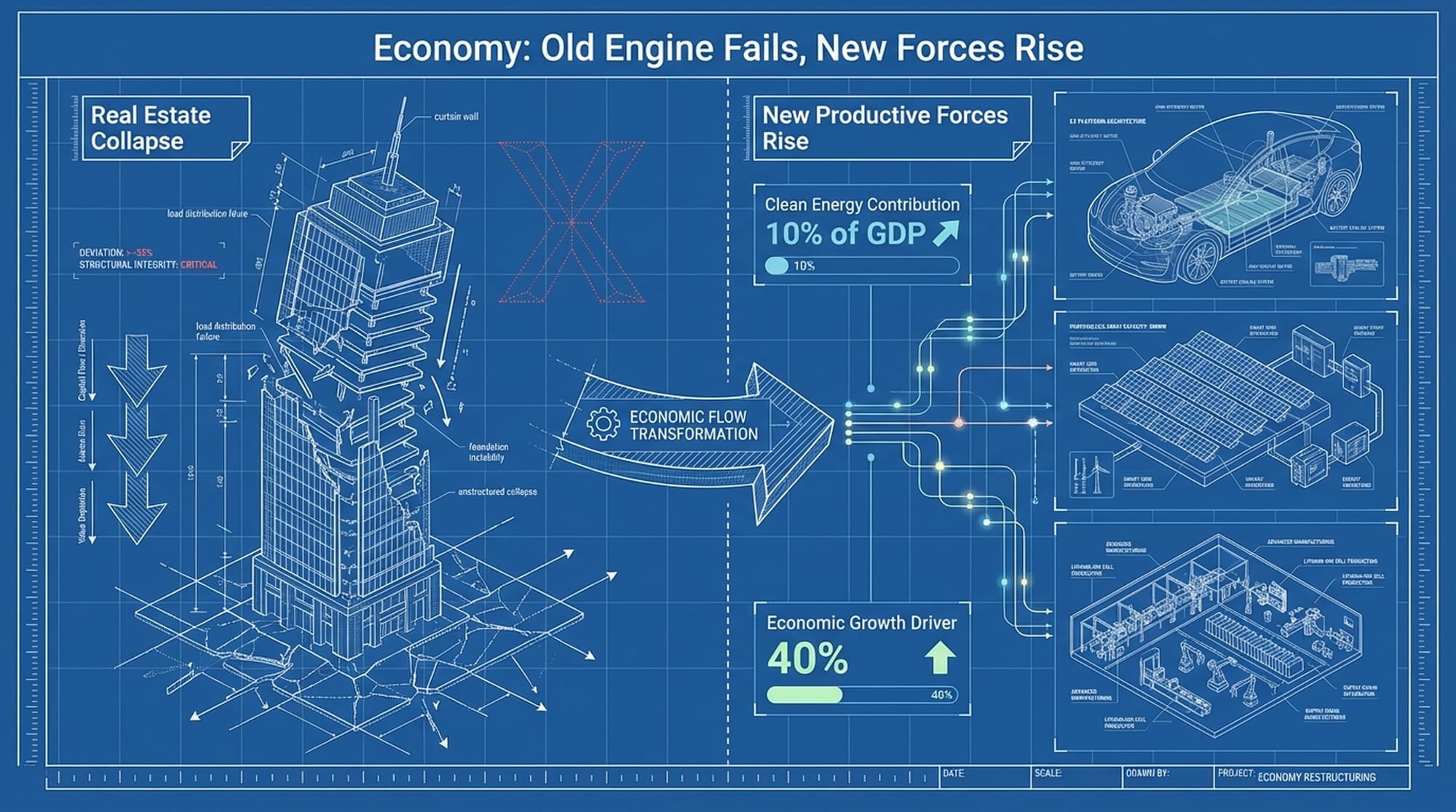
Remarkably, the state has engineered a rapid shift towards New Productive Forces. This includes a significant pivot to green technology, with Electric Vehicles (EVs), batteries, and solar energy now making substantial contributions to the GDP. These sectors are effectively replacing property as the primary driver of industrial activity, demonstrating a massive, directed economic reorientation.
A Fraying Social Contract
Socially, the traditional bargain of prosperity for acquiescence between the Chinese Communist Party (CCP) and its people is under severe strain.
- Structural youth unemployment has reached worrying levels.
- Local governance services are showing signs of breakdown.
The state's response involves a modernized Fengqiao Experience, utilizing digital authoritarianism to atomize dissent. Simultaneously, the Run movement – a surge in emigration – serves as a potent barometer of middle-class pessimism and deeper societal unease. This growing desire to leave the country reflects a significant loss of confidence among a crucial demographic.
"The 'Run' movement – a surge in emigration – is a potent barometer of middle-class pessimism, and a clear signal of deeper unease."
China: A Partial Superpower
While China meets the material definition of a superpower, possessing considerable economic mass and military potential, it remains, in assessment, a partial power. Its limitations include a lack of global alliance structures, significant internal fragility, and an unproven ability to project force globally against a peer competitor.

To fully grasp this Fragile Titan, it is essential to understand its history through three distinct eras, each shaped by crisis:
- 1979-1996:
Million Man Swimto early modernization.- The 1979 Sino-Vietnamese War was a brutal awakening for the PLA, initiating slow professionalization.
- The 1995-1996 Taiwan Strait Crisis acted as the true catalyst, giving birth to the
Counter-Interventionstrategy, also known asAnti-Access/Area Denial (A2/AD).
- 2001-2019:
Era of Strategic Opportunity.- Post-WTO accession, China experienced hyper-growth, funding massive expansion of the
military-industrial complex. - The
Civil-Military Fusionstrategy emerged during this period.
- Post-WTO accession, China experienced hyper-growth, funding massive expansion of the
- 2020-Present: The
New Era.- Under President Xi Jinping, strategic calculus shifted to prioritize
security over pure economic efficiency. - Consolidation of a
fortress mentalityis now evident.
- Under President Xi Jinping, strategic calculus shifted to prioritize
Naval Dominance: A Chasm in Capacity
The conventional wisdom of U.S. military superiority is fundamentally challenged by the sheer industrial scale of China’s defense mobilization, particularly in naval shipbuilding. The disparity between Chinese and American capacity is no longer a gap but a vast chasm.
In 2024, China’s shipbuilding industry was approximately 230 times larger than that of the U.S. in terms of gross tonnage capacity. A single Chinese conglomerate, CSSC, constructed more commercial vessels by tonnage in 2024 than the entire U.S. shipbuilding industry had produced since World War Two. This overwhelming commercial dominance forms the bedrock of China's burgeoning naval power.

Social Ripple and the 'Run' Movement
The economic slowdown has profound implications for social stability. The China Dream of upward mobility is increasingly replaced by a narrative of struggle. Data from the China Dissent Monitor indicates a 27% year-on-year rise in dissent events in Q3 2024, with nearly 1,000 verified incidents.
Key areas of unrest include:
- Labor unrest: demanding unpaid wages, accounting for 41% of dissent.
- Homeowner protests: from the middle class, traditionally the CCP’s base, making up 28% of incidents.
- This
rot from the middlerepresents a new and dangerous dynamic for the Party.
- This
The loss of confidence is physically manifested in the Run movement. Between 2023 and early 2024, tens of thousands of Chinese nationals notably crossed the Darien Gap to reach the U.S. border, a stark indicator of mounting internal pressures and a desire for newfound opportunities elsewhere.

A Formidable, Yet Brittle Giant
How should we classify China in 2025? From a realist perspective, it functions as a successful Regional Hegemon. However, from a liberal standpoint, considering Joseph Nye’s Soft Power, China reveals its intrinsic weaknesses.
My conclusion is that China is best described as a Partial Superpower. It possesses significant economic weight and regional military dominance, yet it notably lacks:
- Global military reach.
- A robust alliance network.
- Widespread soft power appeal.
These limitations prevent it from achieving full parity with the United States.
"Do not underestimate China’s resilience. The industrial base is robust, and the state has a remarkable capacity to mobilize resources for strategic ends."
However, we must not underestimate China’s resilience. Its industrial base is robust, and the state has a remarkable capacity to mobilize resources for strategic ends. Anticipate export shocks and observe the emergence of Peace Disease.
The China of 2025 is a formidable but brittle giant. It is armed with hypersonic missiles, boasts world-leading factories, yet is profoundly anxious about its own people, and governed by a party that prioritizes control above all else. This titan is indeed fragile, and its journey will undeniably define our century.
 |  |  |