 |  |  |
Global Collision Course: Geopolitics, Media-Tech, and the Semiconductor Shake-Up of 2025
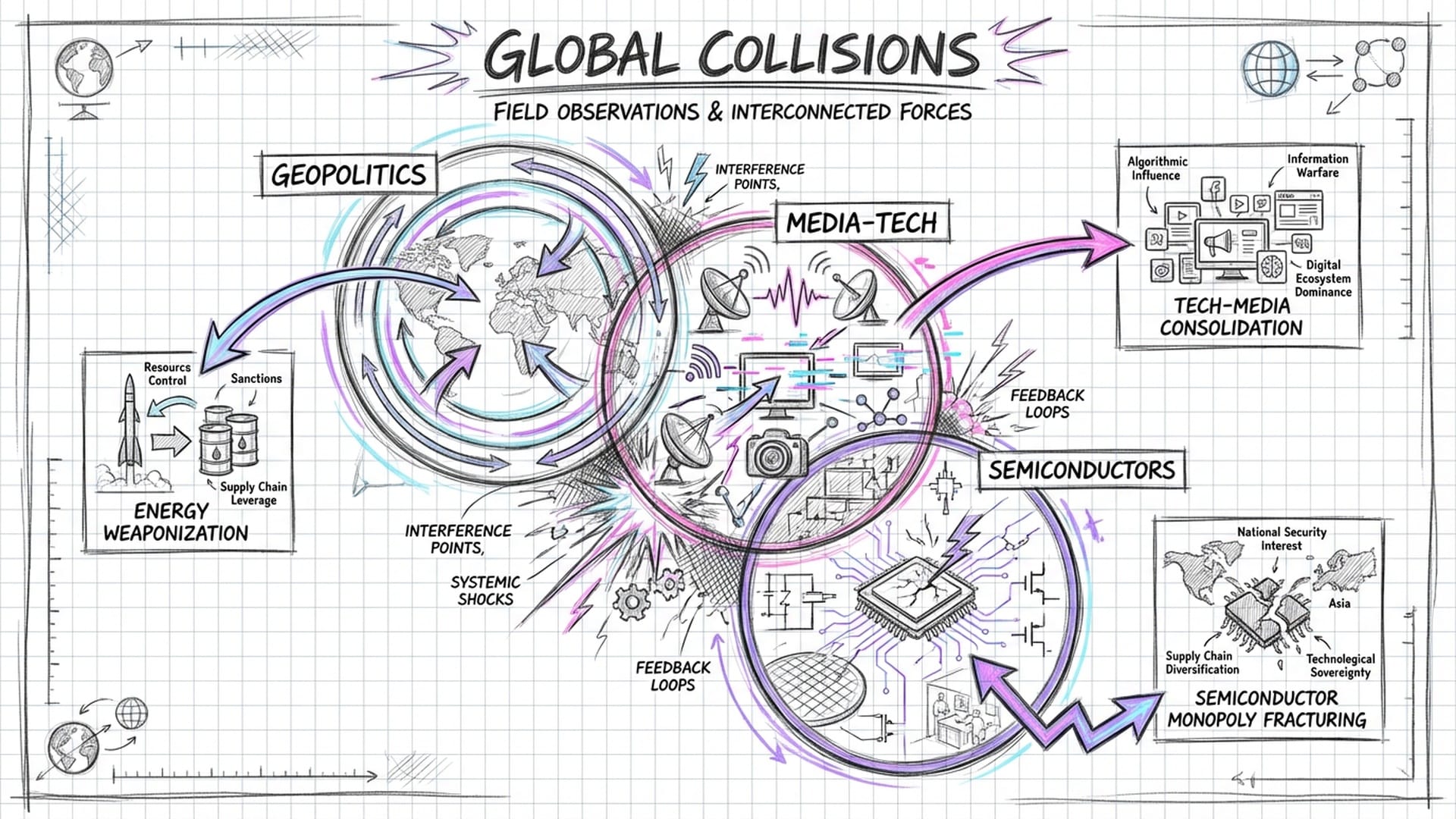
As we close out 2025, the global landscape isn't simply evolving; it's undergoing a fundamental transformation, marked by a violent collision between the raw force of 'Hard Power' geopolitics and the desperate consolidation of 'Soft Power' economic empires. The era of passive globalization is definitively over, replaced by a brutal new paradigm of aggressive resource nationalism and strategic decoupling. To truly understand the forces at play, we must analyze three intersecting vectors that are currently rewriting the rules of global finance and power.
The Three Vectors of Global Reshaping
These aren't subtle shifts; they are seismic events that demand immediate attention from strategists, investors, and policymakers alike:
- The Weaponization of Energy Supply Chains in the Western Hemisphere: A dramatic escalation of hard power to secure critical resources.
- The Desperate Consolidation of the Media-Tech Landscape: A ruthless pursuit of scope and profitability over mere growth.
- The Fracturing of the Global Semiconductor Monopoly: A challenge that threatens to upend technological dominance and national security.
Let's delve into these profound shifts, as the headlines, as always, only tell half the story.
Geopolitics and Energy: The 'Golden Fleet' Doctrine in Action
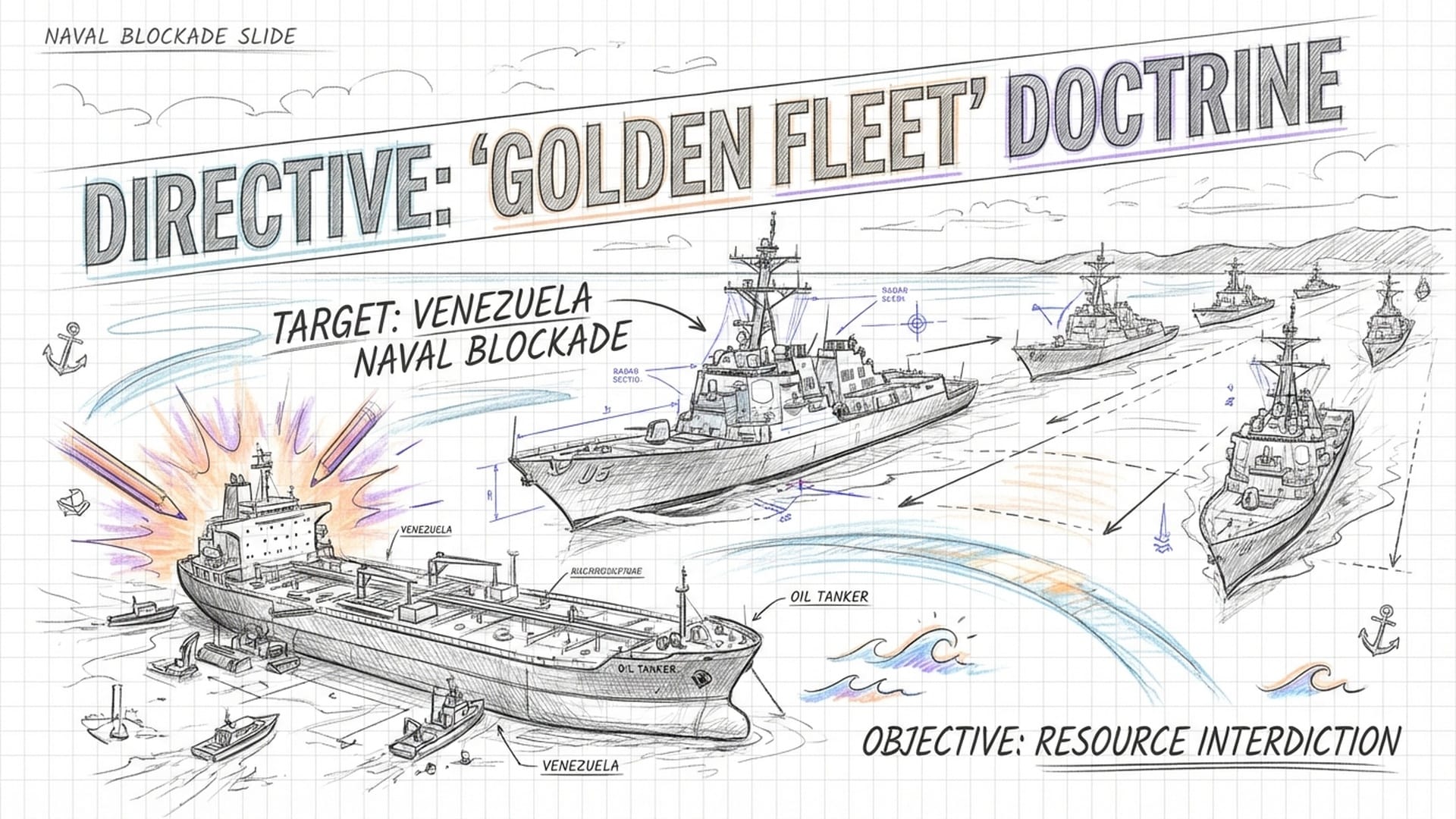
The escalating situation in the Caribbean is far more than a diplomatic spat. The recent U.S. naval blockade of Venezuela signifies a profound move toward active resource interdiction. This isn't theoretical; it's the Golden Fleet doctrine brought to life, raw and undeniable.
"The U.S. naval blockade of Venezuela… represents a profound shift toward active resource interdiction. This is the 'Golden Fleet' doctrine, brought to life, raw and undeniable."
The interception of a Panamanian-flagged tanker, the Skipper, and the closure of Venezuelan airspace mark the most volatile escalation in the region since 2019. While the official line from the State Department cites counter-narcotics efforts and the restoration of democracy, the underlying logic is clear: unadulterated resource security and major power competition.
This is weaponized interdependence made physical — ships in the water, planes in the air, a visceral manifestation of power. The U.S. Golden Fleet initiative, an ambitious plan to revitalize domestic shipbuilding to counter China’s naval dominance, is now undergoing its live-fire test. This blockade is a brutal, real-time beta test of America's capacity to control strategic choke points in its own backyard.
Dual Incentives for the Blockade
The incentives driving this audacious gambit are twofold:
- Force a regime collapse in Caracas: This aims to deny China and Russia a permanent, strategic foothold in Venezuela's vast oil and rare earth reserves – resources critical for the global tech supply chain.
- Stabilize global energy pricing long-term: By bringing the world's largest proven oil reserves back under Western-aligned management, Washington seeks to secure a stable and cheaper energy future.
While this may lead to short-term friction, including economic warfare and potentially kinetic skirmishes, the long-term goal is cheap, secure energy.
Short-term Impact: Expect bullish oil markets. Brent crude prices are likely to find a solid floor, regardless of broader demand softness, as geopolitical risk premiums return with a vengeance. The physical interdiction of tankers will disrupt insurance, logistics, and every calculation of global oil movement. Conversely, it will lead to bearish emerging market risk, as the question who's next? looms large.
Long-term Implications: If successful, this audacious move signals a definitive return to the Monroe Doctrine, potentially securing a stable, cheap energy supply for North America by late 2026. However, failure risks spiraling into asymmetric warfare, fragmenting the delicate Atlantic energy trade, and bifurcating the global oil market into hostile 'Western' and 'Shadow Fleet' spheres. This is a truly terrifying prospect.
M&A and Media Strategy: The End of Fragmented Streaming
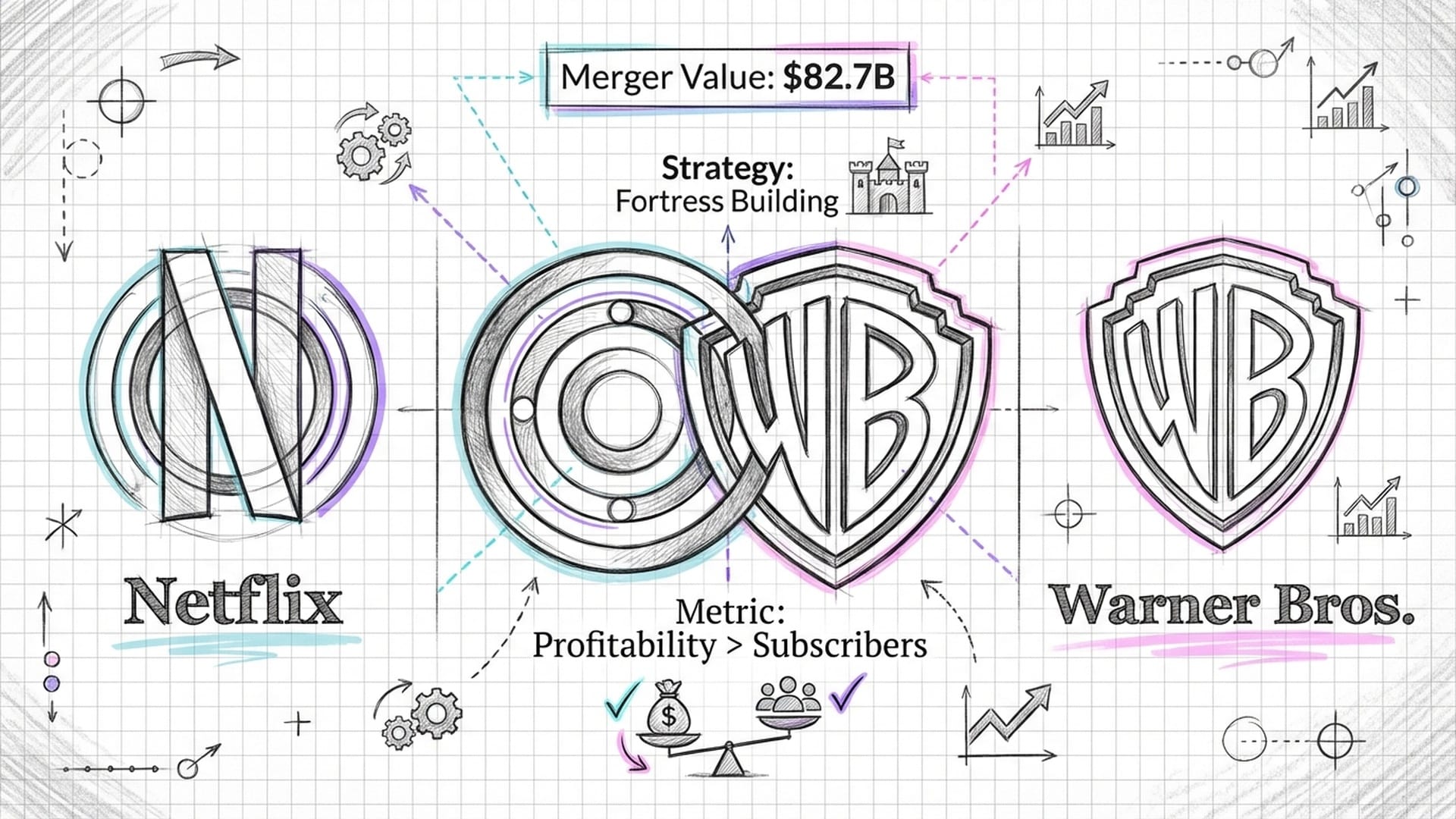
The headline that recently sent shockwaves through the entertainment industry — "Netflix Wins Warner Bros. Discovery for $82.7B, Rejecting Paramount’s Hostile Bid" — is more than just a merger. It signifies the capitulation of the entire 'fragmented streaming' model. The music has stopped.
Warner Bros. Discovery's choice for stability and operational synergy with Netflix, over a higher $108 billion offer from Paramount Skydance, reveals a critical shift. This deal isn't about simple subscriber scale for Netflix; it's about buying scope and building a formidable moat. Netflix is acquiring the prestige of the HBO library and the raw production power of Warner Bros. studio capacity to inoculate itself against churn and become an indispensable, "un-cancellable" behemoth.
Regulatory Chess and the AI Content Flood
The unseen hand guiding this deal is the rapidly changing regulatory environment. This merger directly challenges the Department of Justice’s Antitrust Division, testing their focus on cross-market effects. The fusion of the largest distribution platform (Netflix) with one of the most revered content engines (HBO and Warner) forces regulators to decide:
- Prioritize consumer pricing stability (which this deal might offer through efficiency)?
- Or prioritize market concentration (the fundamental fear of antitrust)?
This move also serves as a defensive posture against the AI content flood. As AI becomes capable of generating endless hours of passable, algorithmically-driven content, this merger is a monumental bet that high-value, human-created, deeply cinematic intellectual property will retain its value, prestige, and power far better than anything a machine can produce. It's a bet on the enduring power of human storytelling, backed by industrial-level production.
Short-term Impact: Expect bullish sentiment in media stocks. This deal validates the age-old content is king thesis, giving a speculative boost to remaining standalone media assets like Paramount, as the market anticipates further consolidation. This is the starter pistol for the mega-merger race.
Long-term Implications: This combination creates a Super-Major in media, forcing aggressive responses from every other player—Disney, Amazon, Apple. It signals the definitive end of the Golden Age of TV overspending, characterized by lavish budgets and niche streaming shows. We are entering an era of disciplined pricing, reduced production volumes, and a fundamental re-altering of Hollywood's economics.
"The party's over, and now it's time to pay the bills."
Tech & Innovation: The Semiconductor Shake-Up
The reports, whispered in hushed, terrified tones from Silicon Valley to Beijing and Washington, confirm the unthinkable: "China Breaks Tech Containment with Prototype EUV Lithography 'Manhattan Project'." Chinese scientists, notably from a facility in Shenzhen, have reportedly developed a functioning prototype for Extreme Ultraviolet (EUV) lithography.
This is not just news; it represents a catastrophic failure of the entire Western 'high fence, small yard' technology denial strategy. For years, the prevailing belief was that ASML’s monopoly on these incredibly complex, impossibly precise machines, essential for making sub-7 nanometer chips, was China’s insurmountable bottleneck. Western strategists rested easy, believing this provided an unassailable advantage.
The rapid development of this prototype, fueled by a secretive, state-directed Manhattan Project and aided by former ASML personnel, suggests China’s timeline for semiconductor self-sufficiency has dramatically accelerated. From a projected 2030, we're now looking at potentially 2027 or even 2028. This isn't just closing the gap; it's leaping over it.
"This is not just news. This is a catastrophic failure. A catastrophic failure of the entire Western 'high fence, small yard' technology denial strategy."
Simultaneously, the broader tech market is experiencing a Hardware Renaissance. Investors are no longer swayed by endless AI hype stocks, as evidenced by Oracle’s recent disappointing performance. The market now demands tangible ROI, pivoting to value the foundational infrastructure required to run AI: chips, energy, and cooling. China’s move to secure the means of production for this infrastructure is not just an economic decision; it is a direct, existential strategic challenge to U.S. national security.
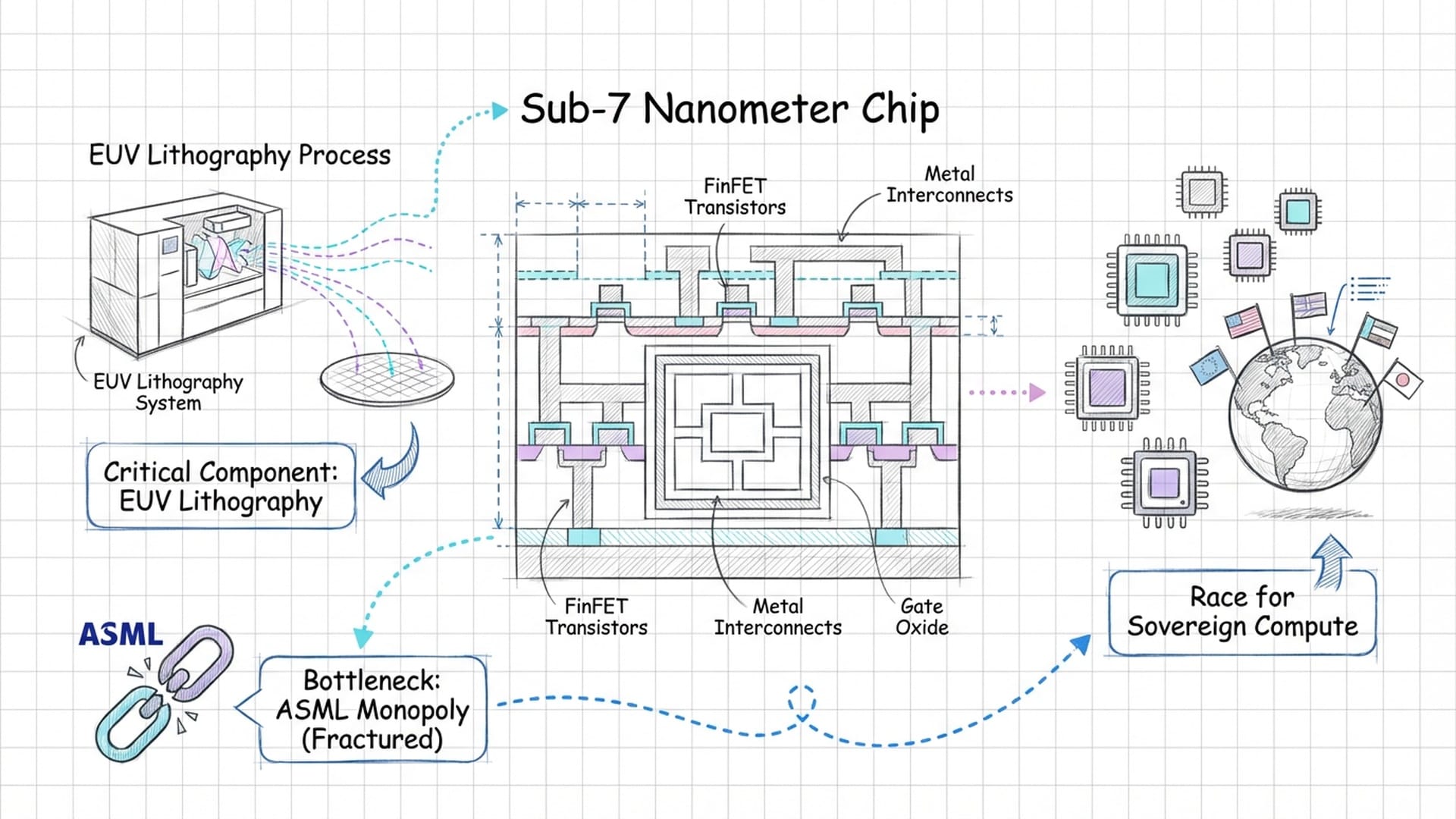
Short-term Impact: Expect bearish trends for semiconductor equipment manufacturers. Western companies like ASML and Applied Materials now face the real specter of a long-term, state-backed competitor in what was once their biggest growth market, introducing unprecedented volatility to the entire semiconductor index. AI, however, remains neutral, as the demand for compute infrastructure continues its upward trajectory.
Long-term Implications: This development utterly destroys the assumption that the West can indefinitely throttle China’s AI development via hardware bans. That bridge is burned. We are now entering a race for sovereign compute. Every nation and major power will spare no expense to build domestic chip supply chains, leading to a massive, mind-bogglingly inefficient duplication of global capital expenditure in technology. This signals industrial policy on a scale not seen since the Cold War.
The Immediate Future: Dominoes Are Falling
The next 24 to 48 hours are absolutely critical, as the immediate future holds two pivotal events that will further shape these evolving dynamics:
1. Diplomatic Fallout: The UN Security Council and Venezuela
Keep a close watch on the UN Security Council’s emergency briefing regarding Venezuela. This will visibly expose the depth of the Russia-China alignment. The key is to observe if Beijing moves beyond mere rhetoric.
- Will they offer economic lifelines?
- Will they insure tankers?
Actions that directly undermine the U.S. naval blockade would cause every risk asset on the planet to immediately re-price, not just for a higher probability of conflict, but for a tangible, terrifying probability of kinetic conflict in the Caribbean. Such a flashpoint would have global repercussions.
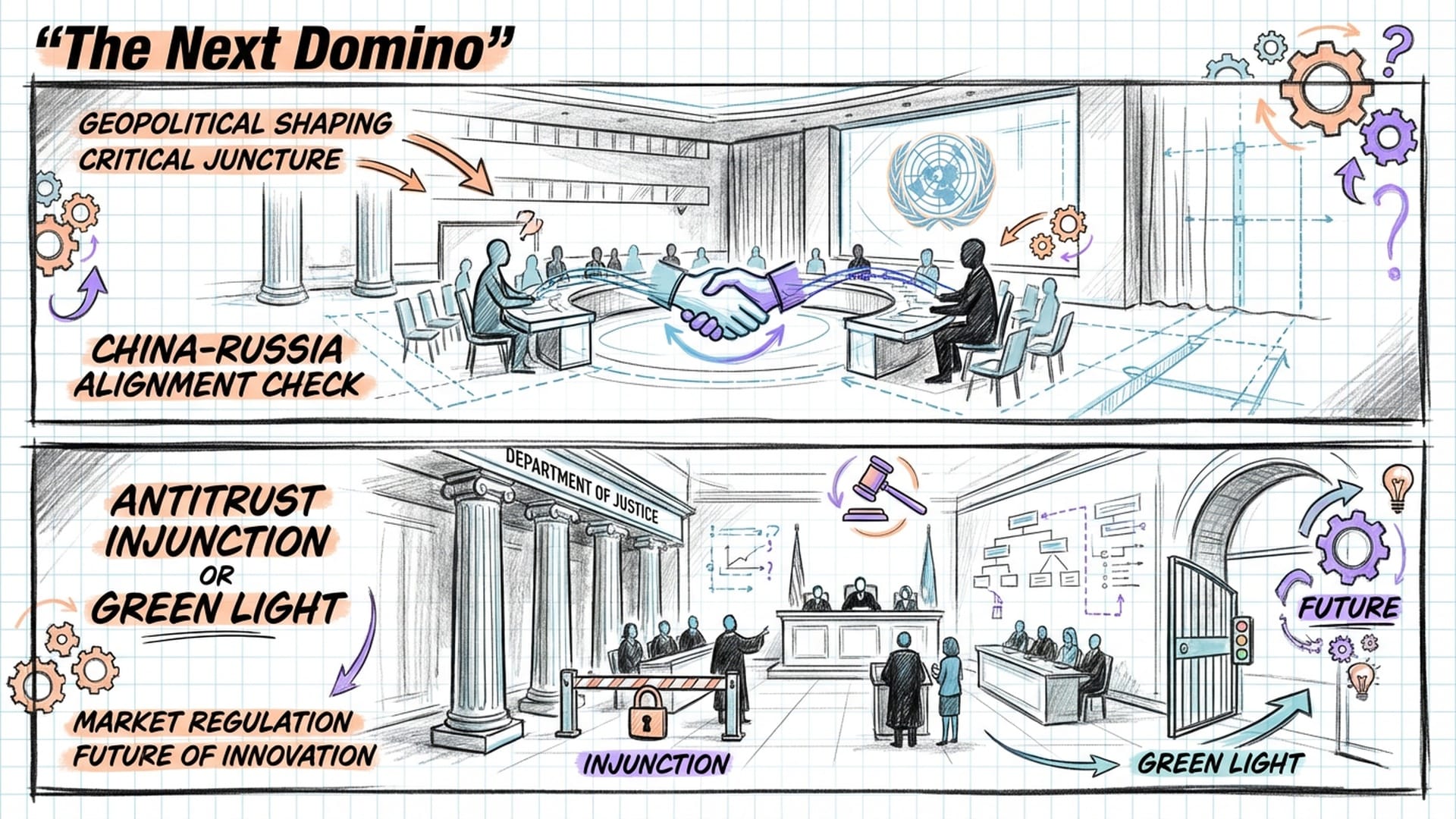
2. Regulatory Response: The DOJ and the Netflix-WBD Merger
Eyes should be glued to the initial comments from Assistant Attorney General Gail Slater regarding the Netflix-Warner Bros. Discovery deal.
- If the DOJ signals an immediate injunction, based on 'cross-market' theories, the current M&A rally and speculative fervor will evaporate overnight. Capital will flee back into safe-haven mega-cap tech stocks, turning defensive once more.
- However, if they signal openness or hint at 'structural remedies' (e.g., divestitures, concessions), that's the green light. This would accelerate global industrial consolidation across every sector, not just media, dramatically into 2026.
Real-Time Indicators: A World Colliding
For those seeking tangible, real-time indicators of this collapsing world order, two specific commodities offer invaluable insights:
- Spot price of rare earth elements
- Heavy crude differentials
These are not obscure commodities. Instead, they will be the first financial indicators, the earliest and most undeniable signals, to react to the tightening noose around the Venezuelan mining arc and its vast oil fields. Their movements will quantitatively reflect the true cost and consequence of a world that is no longer shifting, but truly, violently colliding.

 |  |  |